The First View Is a Hospitality Decision, Not a Decoration Decision
A hotel entrance has only a few seconds to establish its character. Guests may first see the property through a vehicle window, across a drop-off court, beyond planting or while walking toward the lobby. A garden sculpture placed in that sequence can become the visual anchor of the arrival, but only when it is designed for the way the property is actually approached.
For a hotel developer or hospitality landscape designer, the difficult question is not simply whether the sculpture is attractive. The real question is whether it belongs to the arrival experience. A piece can be impressive in isolation and still feel disconnected if its scale, silhouette or position fights with the façade, planting or circulation.
This is where the Pegasus Garden Sculpture route becomes relevant: the starting point is the property, the first view and the role the artwork needs to play — not a catalogue choice made without site context.
Design the Landscape Reveal Before Choosing the Sculpture
The key landscape decision is the reveal: where the sculpture first becomes visible, what frames it and what sits behind it. A hotel entrance may have a long drive axis, a planted bend, a water edge, a forecourt or a compressed drop-off. Each condition changes what the sculpture needs to do visually.
On a long entrance axis, the artwork may need a clear silhouette that remains legible before the guest reaches the building. In a planted resort approach, partial concealment can be useful: the work can appear between trees or beyond a water feature before the full form is revealed. In a tighter urban arrival, the sculpture may be experienced mainly at walking distance, where proportion and surface quality become more important than distant monumentality.
The practical decision is therefore not “which sculpture looks best?” but “how should the landscape reveal the sculpture?” The answer affects silhouette, scale, orientation and the amount of visual detail that can survive against planting and architecture.
Reading the Arrival Composition
Approach distance changes what the sculpture needs to do.
A piece first seen from a moving vehicle needs a cleaner silhouette and stronger overall mass than one discovered at walking distance near the lobby threshold.
Architecture determines whether the sculpture should lead or support.
A restrained façade may benefit from a stronger landmark. A dramatic canopy or highly expressive entrance may need a quieter form that adds identity without competing for attention.
The operating hotel is part of the visual field.
Valet movement, luggage, signage, seasonal planting, lighting and waiting guests all affect how the sculpture is read. The arrival view should therefore be judged under normal hotel operation, not only in an empty rendering.

The entrance can carry one signature piece or introduce a wider visual language.
A single landmark can become the property’s recognisable arrival marker. On a larger resort, related forms can continue deeper into the landscape, provided the entrance piece still has a clear role.
The intended guest memory should be specific.
“Luxury” or “modern” is too broad to guide a useful sculpture brief. Calmness, movement, local character, a photographic moment or a refined architectural presence gives the design team a clearer direction.
How to Shortlist the Right Sculpture for a Hotel Entrance
Compare sculpture concepts in the same real site view before choosing a preferred design. Ask for two or three alternatives shown at a consistent scale from the driveway approach, guest drop-off and lobby threshold. Include the building façade, canopy, mature planting, signs and occupied circulation areas in every comparison. A dramatic isolated rendering is not enough to judge how the artwork will perform at the entrance.
For a long driveway, test whether the outline remains legible from the first clear view; for a compact urban entrance, prioritize guest-level proportions and unobstructed movement. At a planted resort arrival, compare opening-day and mature-landscape views. Beside a reflecting pool, check the artwork’s relationship to the water edge, maintenance access and nighttime reflections. These are comparison tests, not universal height or spacing rules.
A practical selection sequence is to mark the first vehicle view and two pedestrian viewpoints on the site plan; request the same three views for every option; compare approximate height, width and occupied footprint against known façade and canopy dimensions; then record one clear reason for selecting or rejecting each option. Keep any suggested dimensions provisional until the landscape and site teams confirm clearances, foundations and access.
Hotel arrival scenario | Primary decision | Evidence to request
Long entrance drive — legible silhouette at the first clear approach view; show a distant-view photomontage and a guest-level view.
Compact drop-off — visual presence without disrupting guest and valet circulation; show the occupied footprint, door access and a scaled pedestrian view.
Planted resort approach — visibility through seasonal and mature planting; show both current and mature landscape simulations.
Reflecting-water entrance — coherent composition without compromising service access; show day/night reflections, water-edge position and maintenance route.
Decision checklist: Are the approach and pedestrian views documented? Are all options shown at the same scale? Are mature planting, signage and active guest movement included? Is the proposed footprint compatible with the site plan? Has the preferred option been reviewed after dark?
Material Comes After the Visual Role Is Clear
Choosing material too early can narrow the design before the visual job is understood. Pegasus works across stainless steel, bronze, marble, fiberglass/FRP and resin, so the first conversation can begin with the required visual effect, scale and landscape character. Material can then be narrowed according to the approved direction and project conditions.
Stainless steel can support precise contemporary forms and strong interaction with sky or architecture. Bronze can introduce warmth and visual weight. Marble can create a quieter relationship with stone-led architecture and formal landscapes. The correct route depends on the property rather than a universal hierarchy of materials.
Enough Information for a Useful First Conversation
A useful first conversation does not require a finished specification. A landscape plan or arrival rendering, the principal approach, approximate sculpture zone, intended visual character and two or three references are enough for Pegasus to understand the commercial objective and begin discussing a credible direction.
Pegasus states that projects can begin from a simple sketch or reference image and can then be developed into production-ready design. Once the visual direction is agreed, the manufacturer can connect the artistic intent with material development, 3D modelling, structural coordination, fabrication and delivery planning.
Real-World Evidence: Renaissance Charleston Historic District Hotel
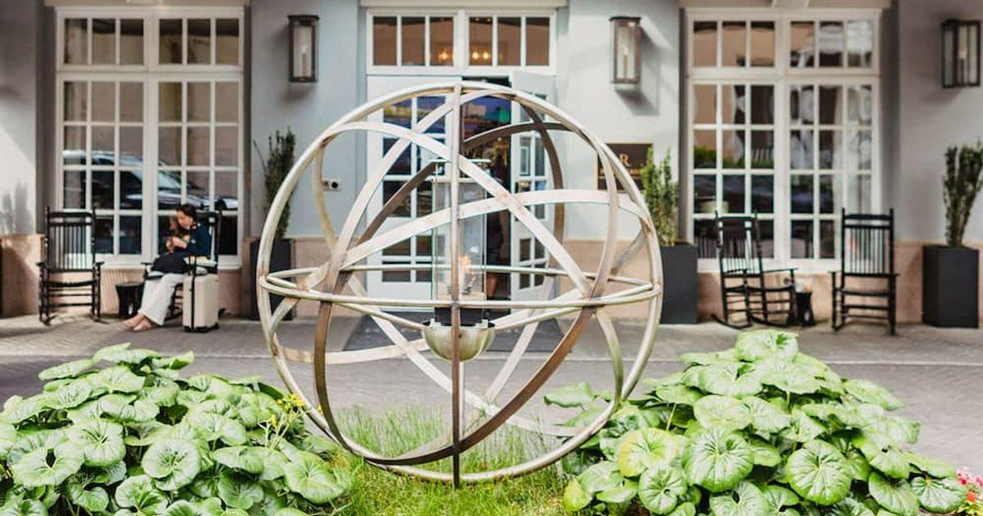
At the Renaissance Charleston Historic District Hotel, Prometheus Art created a sculptural fire feature as part of a re-imagined entrance area. The 2019 work surrounds a vortex flame with bronze and stainless steel, creating a focal point in the courtyard entrance for guests arriving at and leaving the hotel.
The useful lesson for a hotel buyer is not to copy the object. It is to notice how the artwork has a defined job within the arrival sequence: it gives the courtyard a recognisable centre, contributes atmosphere at guest level and is experienced in direct relationship with the entrance rather than as an isolated garden ornament.
Where Pegasus Adds Value at This Buyer Stage
At the arrival-landscape stage, the useful manufacturer contribution is to translate the intended first view into a sculpture direction that can actually be developed and manufactured. The landscape designer defines the visual role; Pegasus can then connect that direction with an appropriate material route, 3D development, structural coordination and fabrication planning.
The strongest first discussion therefore connects three things: what the guest should notice, how the artwork sits with the architecture and landscape, and what material or finish direction can express that idea outdoors. Detailed engineering, final installation planning and quality documentation belong later in the project sequence.
A Better RFQ Starts With the First View
A hotel entrance sculpture should not be commissioned as an isolated object and then fitted into the landscape afterward. A better sequence is to define the first guest view, decide the artwork’s visual role, understand the surrounding architecture and planting, and then bring the manufacturer into the conversation with enough context to respond intelligently.
That gives the developer, landscape designer and manufacturer the same decision framework from the beginning. It also makes the eventual enquiry more useful: instead of “we need a garden sculpture for a hotel,” Pegasus receives a clear commercial objective tied to a real arrival experience.
Planning a hotel or resort arrival landscape? Review the Pegasus Garden Sculpture collection and send the arrival view, proposed location, approximate scale and visual direction for a project-specific discussion.
Frequently Asked Questions
Can an arrival sculpture be coordinated with an existing water feature?
Yes. The first review should consider the water edge, reflections, splash or maintenance zones and the main guest viewpoints so the artwork and water read as one composition.
How can the sculpture remain visible as hotel planting matures?
Review expected planting height and canopy growth against the principal approach views. A sculpture that works on opening day can lose its silhouette later if the landscape is assessed only at installation stage.
Should night viewing be reviewed separately from the daytime arrival?
Yes. Night lighting can change silhouette, reflections, shadow and the apparent relationship between the sculpture and façade, so the key evening approach should be reviewed as its own view.
Can a hotel begin the sculpture discussion before the landscape package is fully complete?
Yes. An early arrival rendering, approximate sculpture zone, principal approach and intended visual character are enough to test direction before detailed coordination begins.
What determines whether a custom hotel entrance sculpture is a modest, moderate or major commission?
The scope depends on overall size, complexity of the form, material and finish, structural requirements, site interfaces and delivery or installation responsibilities. A relatively simple, compact piece generally requires less coordination than a large, intricate arrival landmark. Ask the manufacturer to distinguish essential scope from optional features rather than relying on a broad project category.
What is a reasonable lead-time expectation for a custom hotel sculpture?
Allow for design development, approval of drawings and samples, fabrication, finishing, transport and site installation. A simpler piece may move through these stages faster than a complex, large-scale commission, but there is no reliable minimum or average without the approved design, destination and installation scope. Share the intended hotel opening date early so the supplier can identify schedule risks and confirm a project-specific programme.