A Reorder Is a New Production Event, Not a Photocopy
The first order can look right and sell well, yet the reorder can still arrive as a subtly different product. A cheek becomes warmer, a metallic area loses depth, a cord changes thickness, a removable accessory sits at another angle, or the new insert presses against a fragile projection. None of these changes may look serious in isolation. On the same shelf, however, customers see them as drift.
The risk grows when the reorder happens after a seasonal gap. The original mold may have aged. A pigment, clear coat, adhesive or packaging material may no longer be available. The production team may be different, and the buyer may approve from digital photographs rather than the original object. Repeat-order control begins by preserving a usable product record before those changes occur.
The Reorder Continuity Record
| Record | What It Should Hold | Why It Matters at Reorder |
| Form reference | Approved physical sample plus dated master file and critical dimensions | A photograph cannot prove profile, part fit or scale. |
| Color map | Named color for each zone, physical chip where practical, and approved sample | “Same blue” is not actionable after pigments or lighting change. |
| Finish standard | Sheen, texture, metallic/pearlescent effect and approved viewing conditions | Gloss and special effects can shift even when base color is close. |
| Component register | Material, location and supplier reference for cords, eyes, magnets, bases and labels | Small purchased parts often change before the sculpture does. |
| Mold and master status | Tool identity, storage date, condition check and ownership/retention terms | A stored mold is not automatically production-ready months later. |
| Packaging build | Insert geometry, contact points, accessory positions, carton and label version | A product match can still fail if the new pack loads it differently. |
| Approved deviations | Any intentional handmade variation, tolerances or market-specific differences | Prevents normal craft variation from being treated as a defect. |
1. Preserve a Reference Hierarchy, Not One “Golden Sample”
A golden sample is valuable, but one object should not carry every decision. Its color can age, a projection can be damaged, and handling marks can gradually become mistaken for the original finish. A stronger reference hierarchy separates the evidence: the approved physical sample for overall appearance, a master or verified digital file for form, physical color references for key tones, and dated photographs for placement and assembly.
Each reference should have a version and status. “Approved launch sample – Version 1” is more useful than “sample in storage.” If the buyer later approves a stronger magnet or a revised barcode, that change should create Version 2 without silently replacing the visual standard for everything else.
2. Decide Whether the Existing Mold Is Still the Right Tool
Reusing a mold can reduce development time, but the buyer should not assume that stored tooling will reproduce the original result indefinitely. Before scheduling the reorder, ask the manufacturer to identify the mold, report its condition and cast a fresh verification sample. Review the areas most likely to reveal wear: fine textures, narrow gaps, undercuts, joining faces and edges that must remain crisp.
If a new mold is required, the manufacturer should state what it will be made from: the retained master, an approved production piece or a revised digital model. Those routes can produce different results. The buyer should approve the new-tool sample as a controlled continuation, not as an entirely new sculpture development exercise.
3. Reconfirm Color Under a Shared Viewing Condition
Digital images help communication but are a weak final color standard. Camera processing, screens and surrounding light can make the same ornament look different. For a reorder displayed beside remaining first-run stock, compare the new sample with the retained reference under an agreed neutral light and at the normal viewing distance. Metallic, pearlescent, translucent and high-gloss areas should also be tilted through the light because their appearance changes with angle.
The buyer should identify which color relationships matter most: face against hair, logo against body, two products sharing the same brand blue, or a seasonal family using one coordinated palette. This makes approval commercial rather than theoretical. The objective is not impossible numerical perfection; it is a visually coherent product line.
4. Treat Substitutions as Buyer Decisions
A supplier may need to replace a pigment, clear coat, adhesive, magnet, cord, foam or carton board. Some substitutions are harmless; others change appearance, weight, odor, aging, fit or transit protection. The reorder agreement should require notice before a visible, functional or packaging material changes.
The useful response is proportional. A different outer-carton print batch may only need an artwork proof. A new clear coat on a dark glossy ornament may need a finished sample. A replacement magnet or hanging eye may require a pull or handling check. This keeps buyer approval focused on the consequence of the change rather than creating a factory procedure for its own sake.
5. Rebuild Packaging Around the Approved Product
Packaging is part of reorder continuity because resin ornaments often combine dense bodies with fragile projections. If the ornament is unchanged but the insert material, accessory position or carton size changes, contact pressure can move to a painted face, fingertip, ear or decorative attachment. The first completed pack for the reorder should therefore be opened and reviewed as a product system.
| Packing Check | Buyer Question |
| Product orientation | Is the ornament supported at strong areas rather than painted details or thin projections? |
| Movement control | Can the object, base and accessories move independently during repeated handling? |
| Surface contact | Do foam, tissue, films or ties mark gloss, metallic paint or soft coatings? |
| Accessory count | Are cords, stands, certificates, labels and spare parts listed and located consistently? |
| Retail presentation | Are barcode, artwork, language and unboxing sequence the correct version for this market? |
| Reorder evidence | Are closed-pack and open-pack photographs stored with the final packing specification? |

A Real Pegasus Project: What Must Be Preserved for a Future Extension
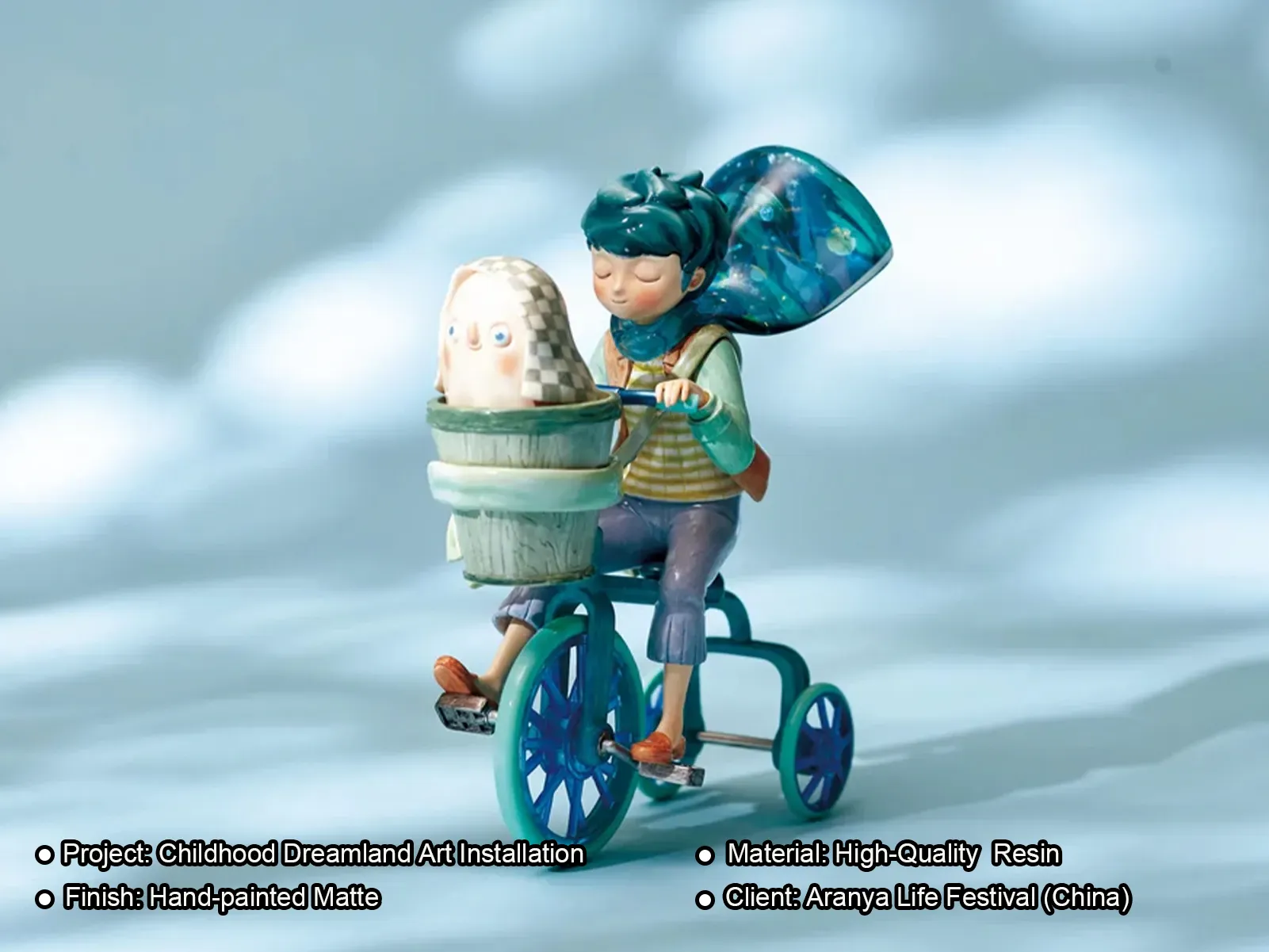
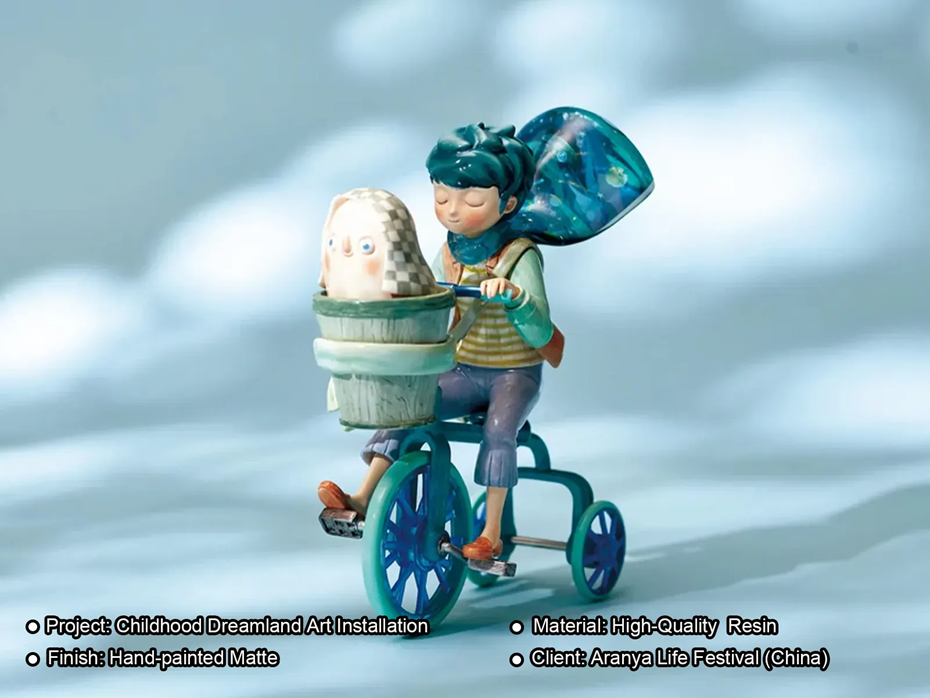
Pegasus identifies the Childhood Dreamland Art Installation as a hand-painted resin project produced for the Aranya Life Festival. The published image shows several continuity-sensitive features: a character face, mapped costume colors, small hands and feet, a wheeled base and a transparent blue element. Together, those features create a recognizable object that cannot be protected by a single color code or front-view photograph.
For any later extension or replacement piece, the practical manufacturing record would need to preserve the approved form, part relationships, transparency reference, color-zone map and packing support points. The public project page does not state that a reorder occurred, so this example is not presented as a reorder case. It is real Pegasus work used to show exactly what a complete continuity record would need to protect.
What the Buyer Should Approve Again – and What Should Stay Locked
| Decision Status | Practical Meaning |
| Usually stays locked | Overall form, scale, approved color relationships, logo/art placement, intended finish and key part interfaces. |
| Reconfirm for every reorder | Mold condition, current material availability, fresh color comparison, component availability, first packed unit and labels/artwork. |
| Approve only if changed | Alternative pigment/coating, new mold, revised component, changed packaging material, new market label or modified accessory. |
| Escalate before production | A substitution that changes appearance, touch, structural behavior, compliance basis, packing pressure or customer use. |
Six Questions to Put on the Reorder Purchase Order
- Reference: Which approved sample, file version, color standard and packaging version govern this reorder?
- Tooling: Will the original mold be used, and what evidence will confirm its condition before quantity production?
- Changes: Which materials, components, suppliers, processes or labels differ from the previous order?
- Verification sample: Which reorder risks must be approved on a fresh finished and packed unit?
- Records: Which photos, color data, component details and pack instructions will be retained for the next reorder?
- Exception handling: Who must approve any change that affects appearance, use or protection?
These questions are deliberately narrower than a full RFQ or factory inspection checklist. They assume the product already exists. Their purpose is to prevent the accepted product identity from being reconstructed from memory when the next commercial order arrives.
Frequently Asked Buyer Questions
Can the original production sample be used forever?
It should remain an important reference, but it can age or become damaged. Support it with dated files, physical color references, dimensions and photographs, and record any later approved change as a new version.
Does using the same mold guarantee the same resin ornament?
No. Tool condition, resin system, curing, trimming, assembly, paint and packaging can all change the result. A fresh verification sample should confirm the current production setup before the reorder expands.
What if the exact pigment or packaging material is unavailable?
The supplier should disclose the substitution and propose evidence appropriate to its effect. A visible coating change may need a finished sample; a packaging change may need a packed-unit review. The buyer should approve the consequence, not merely the new material name.
Should an unchanged reorder need a full approval cycle?
Not necessarily. Keep the product definition locked and reapprove only the current risks: tool condition, material or component changes, color comparison and the first completed pack. This is faster than restarting development and safer than assuming nothing changed.
Make the Next Order Easier Before the First One Leaves
Reliable repeat orders depend on what is retained: a reference hierarchy, a current mold record, a usable color map, controlled component information and a reproducible pack. When those items are versioned, the buyer can review actual changes instead of re-arguing the entire product.
Pegasus can use the previous order record, current quantity, sales market and requested delivery window to define what should remain locked and what needs fresh verification. That gives the reorder a clear commercial starting point: preserve the resin ornament customers recognize while checking only the variables that may have changed.