Selecting a manufacturer for an outdoor stainless steel sculpture is one of the most important decisions in any public art or commercial development project. While design often attracts the most attention, the manufacturing partner ultimately influences structural reliability, installation efficiency, long-term durability, and the overall success of the project.
While many stainless steel sculpture manufacturers present impressive portfolios, finished photographs only tell part of the story. Outdoor installations require careful engineering, precision fabrication, consistent finishing, coordinated logistics, and the ability to manage complex projects from concept through installation. Two manufacturers may offer similar designs and quotations, yet differ significantly in the way they approach fabrication quality, structural planning, communication, and project delivery.
For commercial buyers investing in a landmark sculpture, comparing suppliers systematically helps reduce project risk while improving the likelihood of a successful installation. Rather than evaluating manufacturers solely on price or visual appeal, experienced procurement teams assess technical capability, project experience, quality management, and long-term project support before making a decision.
This guide explains how to compare stainless steel sculpture manufacturers for outdoor installations, highlighting the practical factors that can help buyers identify a manufacturing partner capable of delivering reliable results throughout the entire project lifecycle.
Define Your Project Before Comparing Manufacturers
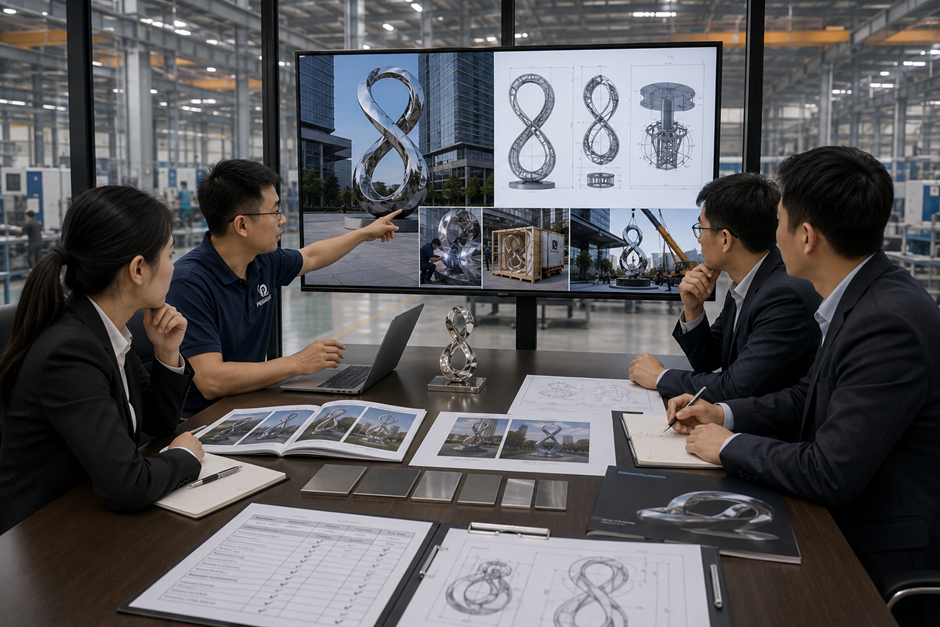
Before comparing suppliers, it is important to establish a clear understanding of the project itself. A well-defined brief allows manufacturers to provide meaningful recommendations while making it easier to compare proposals on more than price alone.
Beyond the sculpture’s dimensions and visual style, buyers should consider:
- Installation location and environmental conditions
- Expected lifespan and maintenance requirements
- Structural loading and foundation considerations
- Preferred surface finish (mirror, brushed, or coloured)
- Project schedule and installation deadline
- Transportation and access restrictions
For example, a sculpture designed for a coastal promenade may require different material specifications and finishing techniques than one installed in a sheltered hotel courtyard. Similarly, sculptures located in high-wind public spaces often require additional structural engineering that should be considered long before fabrication begins.
By defining these requirements early, buyers can evaluate each manufacturer’s recommendations against the actual needs of the project rather than comparing generic quotations.
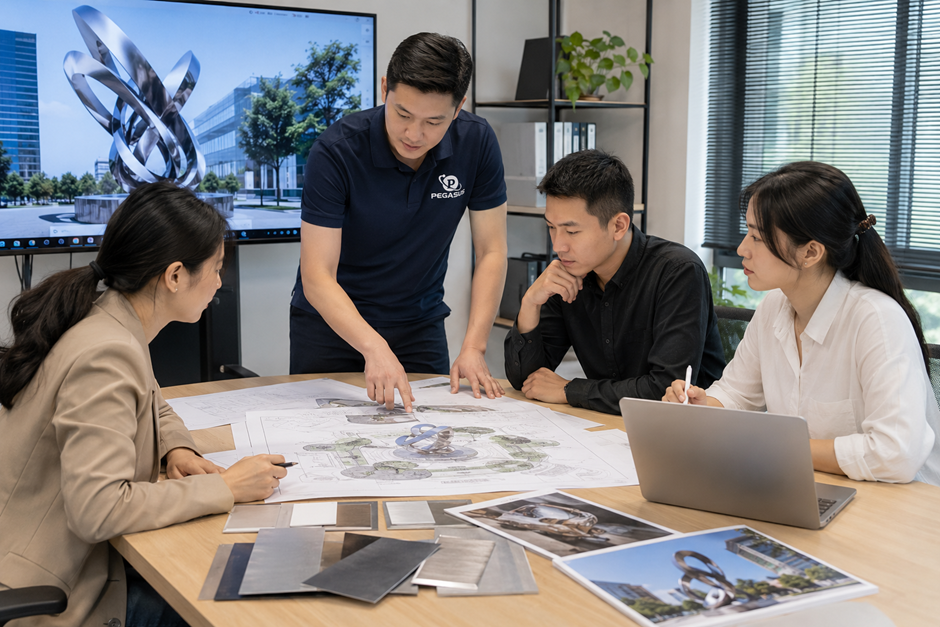
Compare More Than a Portfolio
A polished portfolio can demonstrate artistic capability, but it rarely shows how a manufacturer manages an entire commercial project. When comparing suppliers, buyers should look beyond finished photographs and understand how each company approaches planning, fabrication, quality control, logistics, and installation.
The following comparison provides a practical framework for evaluating manufacturers before making a final decision.
| Evaluation Area | What a Reliable Manufacturer Demonstrates | Potential Warning Signs |
| Outdoor Project Experience | Completed commercial, hospitality, civic, or public art installations | Portfolio limited to studio or showroom pieces |
| Engineering Support | Structural review before fabrication and installation planning | Little discussion of engineering or site conditions |
| Material Selection | Recommends appropriate stainless steel grades and finishes based on environment | Uses identical specifications for every project |
| Fabrication Quality | Consistent welding, polishing, and dimensional accuracy | Visible welds, uneven finishes, or inconsistent detailing |
| Quality Assurance | Documented inspections throughout production | Inspection only after fabrication is complete |
| Packaging & Installation | Custom export packaging and coordinated installation planning | Generic packaging with limited installation guidance |
Rather than asking, “Which supplier has the most impressive photographs?”, commercial buyers often gain more valuable insights by asking, “Which supplier has demonstrated the ability to deliver projects similar to ours from concept through installation?
How Can Buyers Separate Similar Supplier Claims?
Many manufacturers describe themselves using similar terms, such as experienced, quality-focused, technically capable, or internationally recognised. Because these claims are difficult to compare at face value, buyers should evaluate the evidence supporting them rather than relying on the claims alone.
For example, two suppliers may both state that they provide engineering support. However, one may only prepare basic fabrication drawings, while the other reviews wind exposure, foundation requirements, internal reinforcement, lifting points, transportation dimensions, and installation sequencing before production begins. The difference becomes visible only when buyers ask what the engineering process actually includes.
The same principle applies to quality assurance. A manufacturer may claim to maintain strict quality standards, but buyers should confirm whether inspections are documented throughout fabrication or performed only after the sculpture is complete. Inspection records, progress photographs, surface-finish samples, dimensional reports, and approval checkpoints provide more meaningful evidence than general assurances.
When comparing suppliers with similar portfolios and capabilities, buyers should request practical evidence such as:
- Examples of completed projects with comparable scale and installation conditions
- Engineering drawings or technical review documents from previous projects
- Photographs showing fabrication, welding, polishing, inspection, packaging, and installation
- Sample quality-control records or inspection checklists
- A proposed production schedule with clear approval stages
- Details of how project changes, delays, and non-conforming work are managed
- References or case studies demonstrating international delivery and site coordination
A reliable supplier should be able to explain not only what services are offered, but also how those services are delivered, documented, and verified throughout the project.
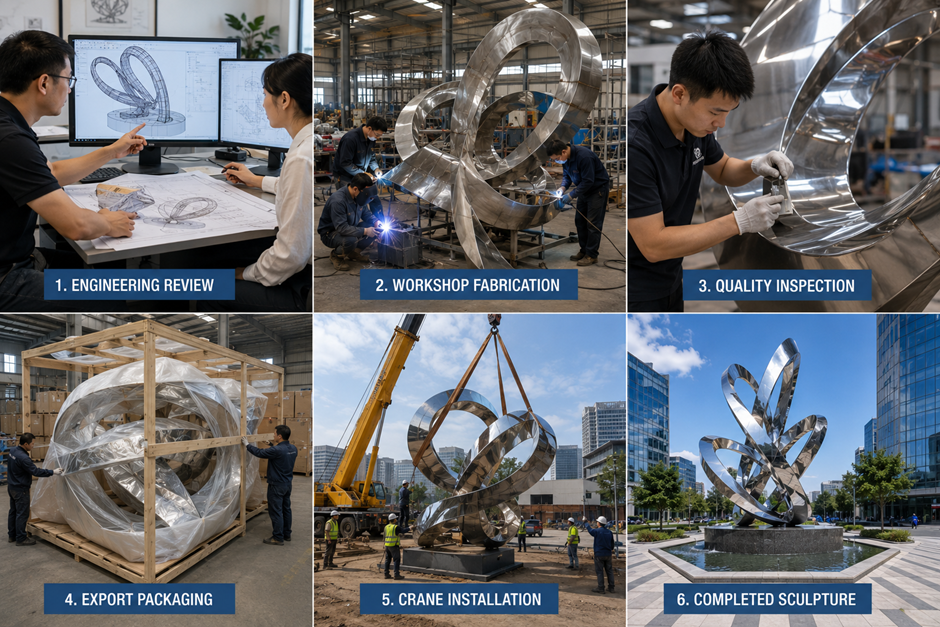
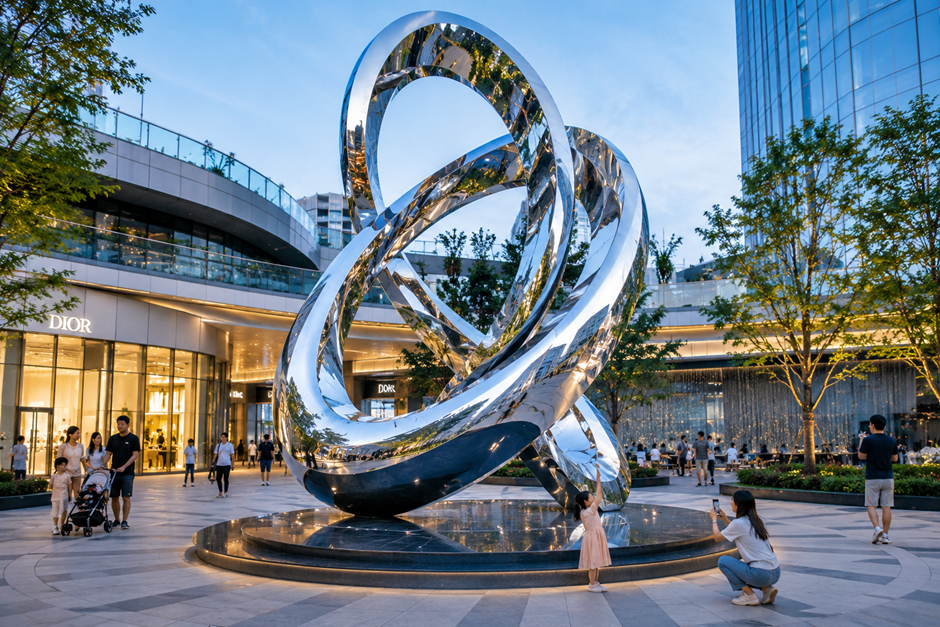
Evaluate Relevant Outdoor Installation Experience
Not every sculpture manufacturer specialises in large-scale outdoor installations. Producing a decorative indoor sculpture is a very different undertaking from delivering a landmark artwork designed to remain outdoors for decades.
When reviewing previous projects, buyers should consider whether the manufacturer has experience with installations comparable to their own. A company that regularly completes sculptures for hotels, commercial developments, public spaces, waterfronts, or mixed-use developments is often better prepared to anticipate the engineering, logistical, and environmental challenges associated with those environments.
Instead of focusing only on aesthetics, it is worth asking questions such as:
- Have similar outdoor projects been completed successfully?
- Were the sculptures installed in environments with comparable weather conditions?
- How were transportation and installation coordinated?
- Were structural considerations addressed before fabrication?
- Can the manufacturer demonstrate complete project workflows rather than only finished photographs?
Reviewing completed outdoor stainless steel sculpture projects often provides greater confidence than browsing a catalogue because it reveals how a manufacturer manages the practical aspects of delivering large-scale outdoor installations from planning through final placement.
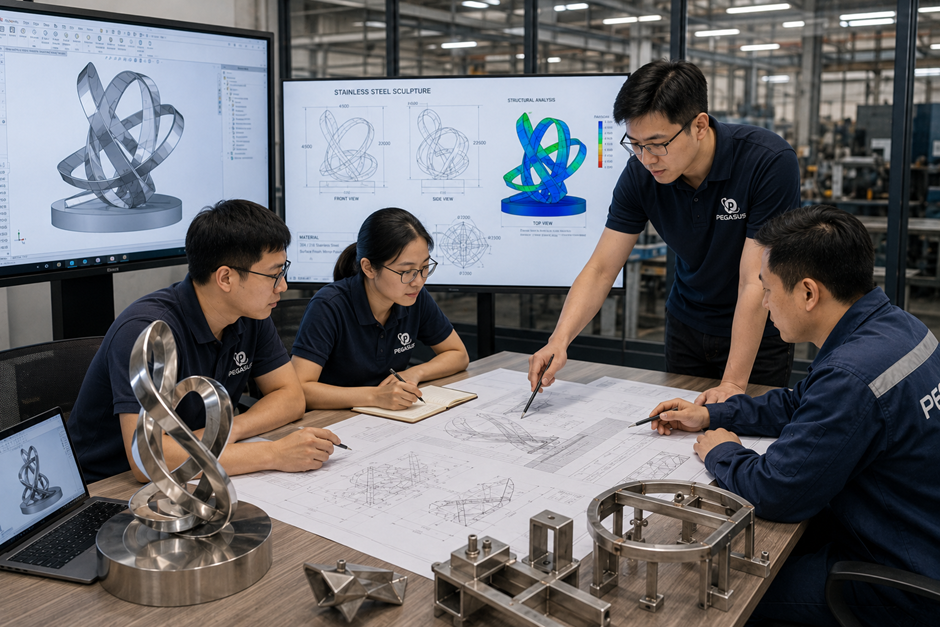
Why Engineering Matters Before Fabrication Begins
One of the biggest differences between experienced and inexperienced manufacturers often becomes apparent before fabrication even starts.
Outdoor stainless steel sculptures must accommodate structural loads, wind exposure, transportation requirements, lifting methods, and long-term stability. Addressing these factors during engineering can prevent costly modifications later in the project.
At Pegasus, engineering review begins before fabrication, allowing the project team to evaluate structural requirements, installation methods, and fabrication feasibility while designs can still be refined efficiently. Commercial buyers comparing suppliers should look for this level of early technical planning, as it often reduces project risk while improving installation efficiency.
Questions worth discussing during supplier evaluation include:
- How is the internal structure engineered?
- Will the sculpture require hidden reinforcement?
- How are lifting points incorporated?
- Have transportation dimensions been considered?
- Are installation constraints reviewed before fabrication begins?
These conversations often reveal far more about a manufacturer’s capability than a portfolio of completed sculptures alone.
Buyers should also compare the technical information each supplier is prepared to provide before production begins. A brief confirmation that engineering has been considered is not equivalent to a documented structural review. Depending on the project, useful deliverables may include internal framework drawings, anchoring details, lifting-point plans, transportation dimensions, foundation requirements, and installation instructions. The quality and completeness of these documents often reveal how thoroughly the manufacturer has evaluated the project.
Compare Material Selection—Not Every Outdoor Project Requires the Same Specification
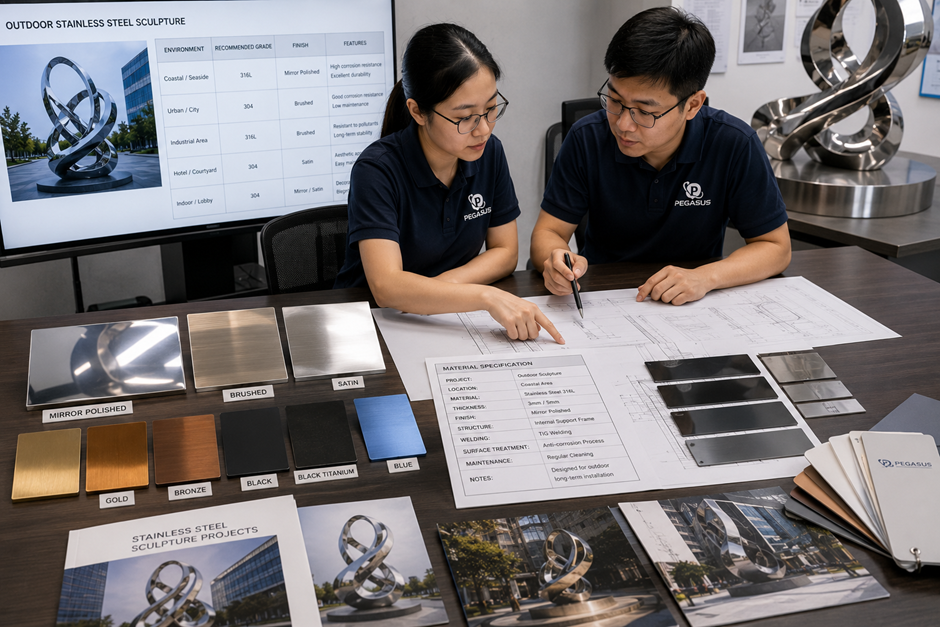
One of the most common misconceptions during supplier evaluation is assuming that all stainless steel sculptures are manufactured using the same materials. In reality, the choice of stainless steel grade, sheet thickness, internal framework, and surface finish should be determined by the sculpture’s location, scale, and environmental conditions rather than applying a single specification to every project.
For outdoor installations, these decisions directly influence long-term performance. A sculpture installed in a coastal environment, for example, faces different challenges than one placed within a sheltered hotel courtyard or an urban commercial plaza. Environmental exposure, humidity, airborne pollutants, and ongoing maintenance expectations should all be considered before fabrication begins.
Rather than asking, “What material do you use?”, experienced buyers often ask:
- Why is this material suitable for my project?
- How does the installation environment influence the recommendation?
- What maintenance should be expected over time?
- How will the selected finish perform outdoors?
A manufacturer that explains why a particular specification is recommended usually demonstrates a more considered approach than one offering the same solution for every project.
Buyers interested in understanding how stainless steel sculptures evolve from early concepts through fabrication may also find How Stainless Steel Sculpture Manufacturers Transform Creative Concepts into Iconic Installations helpful, as it explores the broader development process behind custom projects.
Fabrication Quality Is Often Revealed in the Details
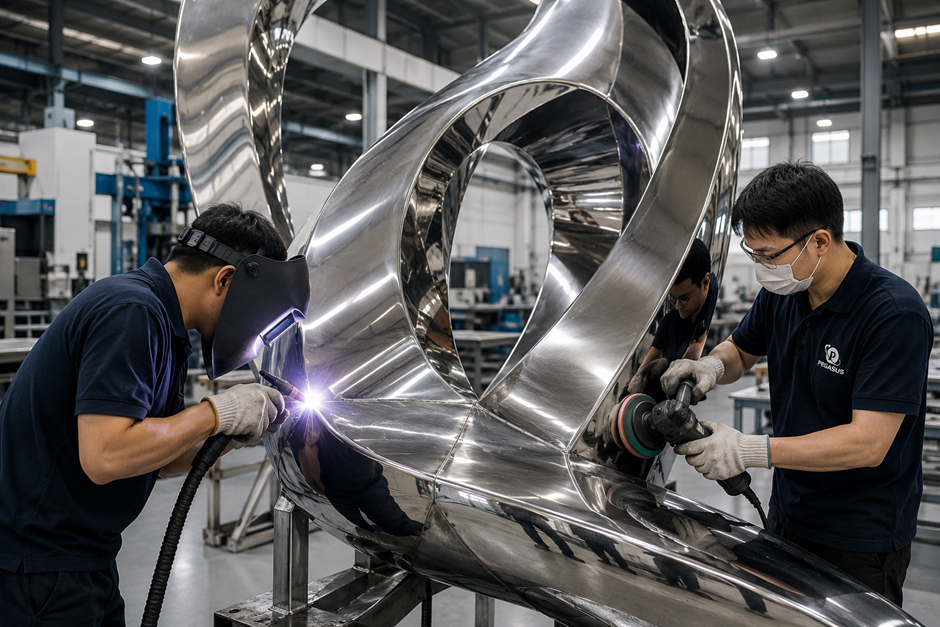
Two completed sculptures may appear almost identical from a distance, yet the quality of fabrication often becomes apparent when viewed more closely. Weld consistency, panel alignment, surface transitions, and polishing quality all influence the finished appearance, particularly for mirror-finished sculptures where even minor imperfections become highly visible.
For outdoor projects, fabrication quality also affects long-term durability. Consistent workmanship can reduce the likelihood of visible surface irregularities, simplify maintenance, and help preserve the sculpture’s appearance after years of environmental exposure.
When comparing a stainless steel sculpture factory, buyers may wish to review more than finished photographs. Asking about fabrication methods, quality checkpoints, and finishing procedures often provides a better understanding of the manufacturer’s capabilities.
Useful questions include:
- How are welds blended into the surrounding surface?
- What polishing process is followed before final inspection?
- How is dimensional accuracy maintained throughout fabrication?
- Are individual components inspected before final assembly?
- How are reflective finishes protected during handling?
These practical discussions frequently reveal the level of craftsmanship behind a project long before fabrication is complete.
Quality Assurance Should Continue Throughout Production
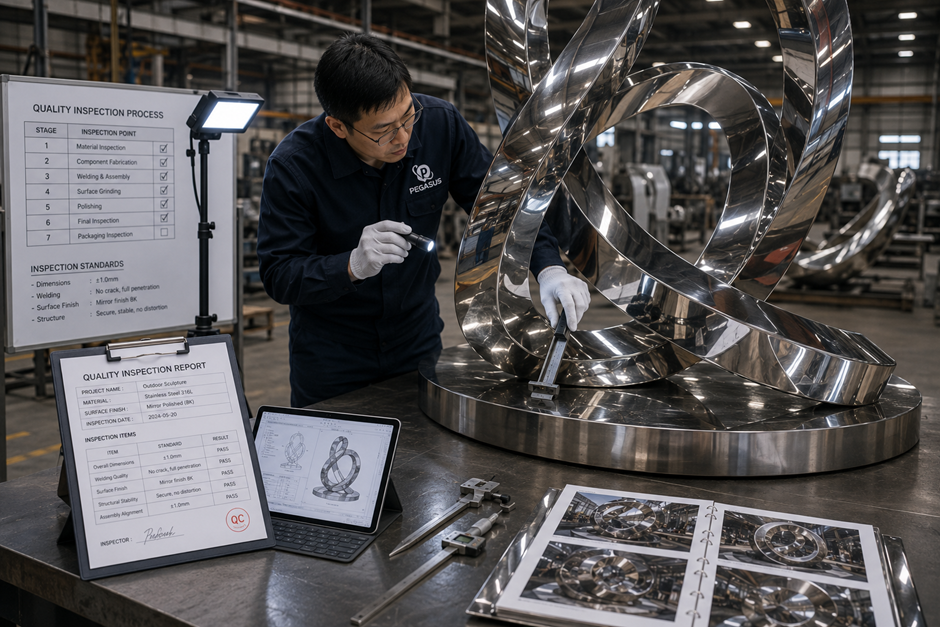
For large commercial sculptures, quality assurance is most effective when it forms part of the manufacturing process rather than being treated as a final inspection before shipment.
Each production stage presents an opportunity to verify dimensions, surface quality, structural alignment, and finishing consistency before the sculpture progresses to the next phase. Addressing small issues early can reduce rework while helping maintain consistency across larger projects involving multiple fabricated components.
At Pegasus, quality inspections are integrated throughout production, allowing fabrication, polishing, and finishing work to be reviewed at multiple stages before a sculpture is prepared for shipment. Buyers evaluating any manufacturing partner should look for a similarly structured quality management process rather than relying solely on photographs of completed work.
During supplier discussions, consider asking:
- At which production stages are inspections performed?
- How are dimensional tolerances verified?
- How is surface finish consistency maintained?
- What documentation accompanies final approval before packaging?
These conversations often provide a clearer picture of operational discipline than marketing materials alone.
Buyers can further distinguish between suppliers by asking how inspection results are recorded and shared. A manufacturer that provides dated progress photographs, dimensional checks, welding reviews, finish approvals, and corrective-action records offers greater transparency than one that provides only a final completion photograph. This documentation gives the client an opportunity to identify and resolve concerns before the sculpture is packaged or shipped.
Compare Logistics and Installation Support—Not Just Manufacturing
Even a perfectly fabricated sculpture can encounter challenges if transportation and installation planning have not been considered from the outset.
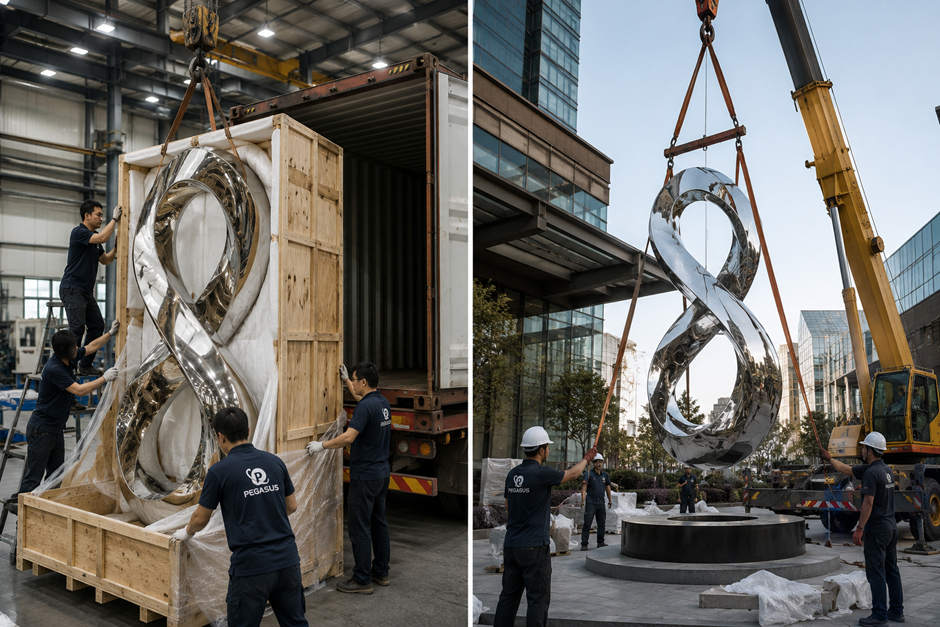
Large outdoor stainless steel sculptures often require coordinated lifting operations, custom export packaging, specialised transportation, temporary storage, and carefully sequenced installation. These logistical considerations are particularly important for sculptures destined for hotels, public plazas, mixed-use developments, and civic projects where installation must align with broader construction schedules.
Manufacturers with experience in commercial installations typically discuss logistics well before production is complete. Protective wrapping, reinforced export crates, lifting points, shipment sequencing, and site access planning all contribute to a smoother installation process while reducing unnecessary handling risks.
Rather than viewing logistics as a final step, experienced buyers often evaluate how early these discussions begin during supplier selection. A manufacturer that considers transportation and installation during project planning is generally better positioned to anticipate practical challenges before they become costly delays.
The level of detail in a supplier’s logistics proposal can also help buyers compare capabilities. A well-prepared manufacturer should be able to explain how the sculpture will be divided if necessary, where lifting points will be located, how polished surfaces will be protected, how the crate will support the sculpture during transit, and what equipment will be required at the installation site. These details demonstrate whether logistics have been integrated into the project plan or left until production is nearly complete.
Readers interested in broader applications of large outdoor metal sculptures can also explore Why Large Outdoor Metal Sculptures Are Reshaping Modern Architecture, Luxury Spaces and Public Art, which examines how large-scale sculptures are increasingly integrated into contemporary developments.
Review the Complete Project Delivery Process—Not Just the Finished Sculpture
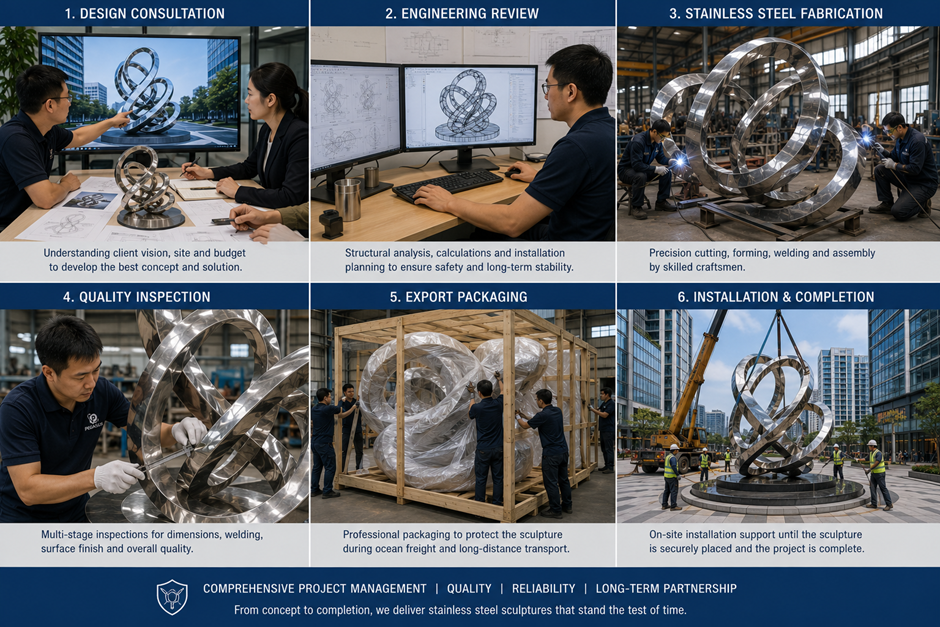
One of the clearest ways to compare stainless steel sculpture manufacturers is to understand how they manage an entire project from initial consultation to final installation. While completed sculptures demonstrate artistic capability, they do not always reveal the planning, coordination, and technical processes required to deliver a successful outdoor installation.
Experienced manufacturers typically follow a structured workflow that allows design, engineering, fabrication, logistics, and installation to progress in a coordinated manner. Reviewing this process helps buyers evaluate how potential challenges are identified and managed before they affect the project timeline.
A comprehensive project delivery process often includes:
- Initial project consultation
- Site assessment and technical review
- Engineering and structural planning
- Material specification and finish approval
- Fabrication and welding
- Surface finishing and polishing
- Multi-stage quality inspections
- Protective export packaging
- Transportation and site coordination
- Installation support and project completion
For commercial buyers, understanding this complete workflow often provides greater confidence than evaluating finished sculptures alone because it demonstrates how the manufacturer approaches the practical aspects of project execution.
Real Project Example: Coordinating a Landmark Outdoor Sculpture Installation
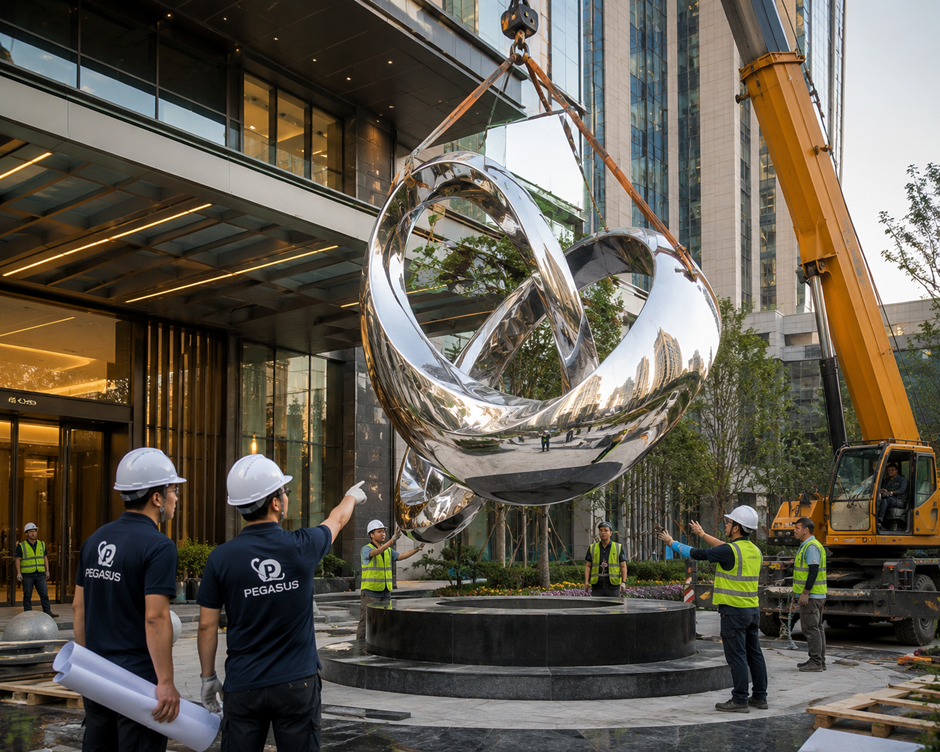
A commercial mixed-use development commissioned a large mirror-polished stainless steel sculpture as the focal point of its main public entrance. Because the sculpture formed part of a wider construction programme, its design, transportation, and installation needed to be coordinated with foundation work, access routes, landscaping, and the scheduled opening of the property.
During the engineering phase, the fabrication team reviewed wind exposure, internal reinforcement, foundation integration, transportation dimensions, and the proposed lifting strategy. This review identified that the original lifting approach would have required additional site access and a larger crane during installation. By revising the lifting points and installation sequence before fabrication began, the project team was able to use the available access route and coordinate the installation with the contractor’s existing equipment plan.
Material specifications and surface-finish samples were approved before production commenced. Mock-up reviews and formal approval checkpoints gave the architect and developer an opportunity to confirm the sculpture’s proportions, reflective finish, and visual relationship with the surrounding architecture before full-scale fabrication moved forward.
Throughout manufacturing, scheduled inspections covered dimensional accuracy, structural alignment, welding consistency, polishing quality, and final surface protection. Progress photographs and inspection updates allowed the client team to review the work remotely and resolve questions before the sculpture was prepared for shipment.
The sculpture was then secured using custom export packaging designed around its shape, polished surface, lifting points, and transportation route. Installation was coordinated with the contractor’s programme so the sculpture could be positioned before the surrounding landscaping and hardscape works were completed.
The commercial value of this planning extended beyond the sculpture itself. Early engineering reduced the risk of last-minute structural changes, coordinated logistics prevented unnecessary site handling, and phased approvals helped protect the construction schedule. The completed installation provided the development with a distinctive visual landmark while avoiding disruption to the wider site programme.
This example demonstrates why buyers should compare manufacturers not only on their ability to fabricate a sculpture, but also on their ability to identify risks, coordinate stakeholders, protect project schedules, and support the commercial objectives behind the installation.
Building a Long-Term Manufacturing Partnership
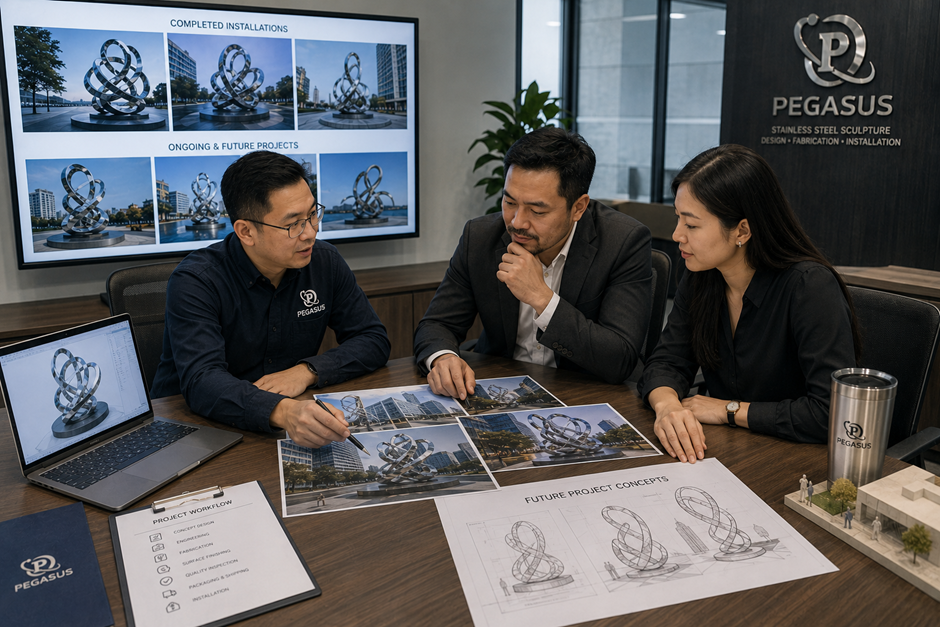
Selecting a stainless steel sculpture factory is not simply about completing a single project. For many architects, developers, landscape designers, and commercial organisations, establishing a reliable manufacturing partnership creates long-term value across multiple projects.
Manufacturers that communicate clearly, provide practical engineering guidance, maintain consistent production standards, and support installation planning often become trusted partners rather than one-time suppliers. This collaborative approach allows future projects to progress more efficiently because both parties already understand established quality expectations, approval processes, and project workflows.
At Pegasus, this collaborative approach extends beyond fabrication. By working closely with clients from the early planning stages through production, logistics, and installation support, the team aims to help commercial projects progress with greater confidence and coordination.
For organisations planning multiple public art installations, hospitality developments, or commercial landscape projects, choosing a manufacturing partner capable of supporting the entire project lifecycle can often deliver greater long-term value than evaluating quotations alone.
Conclusion
Comparing stainless steel sculpture manufacturers involves far more than reviewing portfolios or requesting quotations. Successful outdoor installations depend on selecting a manufacturing partner capable of combining engineering expertise, fabrication quality, structured quality assurance, reliable logistics, and coordinated installation support into one integrated process.
By evaluating project experience, material recommendations, fabrication standards, inspection procedures, packaging methods, communication practices, and complete project delivery workflows, commercial buyers can make more informed decisions while reducing unnecessary project risks.
For organisations planning a custom outdoor stainless steel sculpture, investing time in comparing manufacturers before production begins often leads to smoother project execution, improved long-term performance, and greater confidence throughout every stage of the installation.
Frequently Asked Questions
How should I compare stainless steel sculpture manufacturers?
Compare manufacturers based on relevant outdoor project experience, engineering capability, fabrication quality, quality assurance procedures, logistics planning, and installation support rather than relying solely on portfolios or pricing.
Why is engineering important for outdoor stainless steel sculptures?
Engineering ensures the sculpture is designed to withstand environmental conditions, transportation, lifting, and installation requirements while maintaining long-term structural stability.
What should I ask before choosing a stainless steel sculpture factory?
Ask about previous outdoor projects, material recommendations, quality inspection procedures, welding standards, export packaging, transportation planning, and installation coordination.
Why does installation experience matter when selecting a manufacturer?
Manufacturers with installation experience are often better prepared to coordinate lifting operations, site access, transportation sequencing, and construction schedules, helping reduce unnecessary project delays.
Can project management be as important as fabrication quality?
Yes. Large outdoor sculpture projects often involve architects, contractors, engineers, and logistics teams. Effective communication and structured project management help ensure each stage progresses efficiently from concept through installation.
When should a manufacturer become involved in an outdoor sculpture project?
Ideally during the planning stage. Early collaboration allows engineering requirements, material specifications, fabrication methods, transportation planning, and installation considerations to be addressed before production begins.