A Better Quote Starts With a Better Project Brief
When a commercial sculpture project reaches the quotation stage, the quality of the information supplied at the beginning can determine how useful the quotation will be. A request that says only “we need a large fiberglass sculpture” leaves important questions unanswered: How large? For an indoor or outdoor site? One piece or several? Is there an approved model or only a reference image? What finish is required? How will the sculpture reach the installation area?
For a custom fiberglass sculpture, these details are not administrative extras. They influence design development, mold strategy, reinforcement, surface finishing, sectional construction, packaging, shipping and installation planning. A clearer brief reduces assumptions and gives both buyer and manufacturer a better basis for discussing feasibility, scope, schedule and cost.
Pegasus states that projects can begin from a simple sketch or reference image; completed technical drawings or 3D files are not mandatory at the inquiry stage. Its published capabilities include concept development, 3D modeling, CNC-supported production development, project-stage approvals, quality inspection, export packaging and installation support. That makes the RFQ stage the right place to establish what information already exists and what still needs to be developed.
What Should a Custom Fiberglass Sculpture RFQ Include?
The most useful RFQ is not necessarily the longest one. It is the one that gives the manufacturer enough information to understand the artistic objective, commercial use, physical constraints and delivery requirements. The following eight inputs create a practical starting point.
1. Project Type and Intended Use
Start by explaining what the sculpture is for and where it will be used. A hotel lobby centerpiece, retail display, theme-park character, landscape feature and public-space installation may all use FRP, but their practical requirements can differ. Include the role of the sculpture in the space, expected viewing distance, likely visitor contact and whether it forms part of a wider architectural, landscape or branded environment. If a site plan or rendering exists, include it.
2. Overall Dimensions and Quantity
Provide the intended height, width and depth, even if they are preliminary. For unusual forms, an annotated sketch can be more useful than a single height measurement. Quantity also matters. A one-off landmark and a repeat program of fiberglass statues for several locations may require different mold, consistency, packing and scheduling decisions. Pegasus states that it accepts single custom projects depending on design and scale, so buyers should state the required quantity at RFQ stage rather than treating it as a later purchasing detail.
3. Design Files and Visual References
Send whatever information is genuinely available: concept sketches, reference photographs, architectural renderings, CAD drawings or 3D files. Pegasus states that its team can develop a production-ready design from a simple sketch or reference image and publishes 3D modeling capabilities using Rhino and ZBrush. Identify the design status clearly — concept only, preliminary, approved, or production-ready — so design-development work is not confused with fabrication scope.
4. Surface Finish, Color and Appearance
Describe the intended visual result rather than relying on a vague phrase such as “premium finish.” Provide color references, gloss or matte preference, metallic or stone-effect direction, branding colors and any approved sample or reference photograph. If the sculpture will sit under strong architectural lighting, mention that too. Where appearance is critical, a physical finish sample or agreed reference is more useful than judging color only from a monitor.
5. Indoor, Outdoor or Semi-Exposed Environment
State where the sculpture will be installed. For exterior projects, provide useful site information such as coastal exposure, strong sunlight, humidity, temperature variation, public contact and other known environmental constraints. Pegasus’s published FRP specification describes 4 layers of resin slurry plus 4 layers of fiberglass mat with a standard finished thickness of approximately 5–8 mm; however, the buyer’s RFQ should first describe the real environment so the appropriate reinforcement and protective finish can be evaluated for the project.
6. Site Access, Delivery Destination and Installation Constraints
Include destination city and country, doorway or elevator limitations, access routes, lifting constraints and any known maximum transport dimensions. Large sculptures may need to be divided into engineered sections for transport. Pegasus publishes export packaging and installation-support capabilities; if the buyer expects assembly drawings, remote guidance, installation documentation or on-site technical assistance, those expectations should be identified before quotation.
7. Required Schedule and Approval Milestones
Provide the date the sculpture is actually required on site, together with any earlier milestones such as design approval, finish/sample approval, factory inspection, shipping deadline or venue opening. Pegasus’s FAQ states that many projects take around 45–90 days after design confirmation depending on size and complexity. This should be treated as a general published range, not a promise for every project; the project-specific schedule should be confirmed after scope review.
8. Approval, Inspection and Documentation Requirements
Commercial buyers often need more than the finished sculpture. List any required progress photographs, video reviews, model approvals, finish samples, dimensional checks, inspection records, packing documentation, assembly drawings or installation guidance. Pegasus states that its structured approval process confirms designs before production and provides updates at key stages. Defining these approval gates during quotation makes responsibilities clearer and reduces late-stage misunderstandings.
A Simple RFQ Checklist for Procurement Teams
- Project name, type and intended use
- Installation location and environment
- Approximate height, width and depth
- Required quantity
- Concept sketch, reference images, CAD or 3D files if available
- Required colors, finish and visual references
- Indoor / outdoor / semi-exposed conditions
- Site access, lifting and installation constraints
- Delivery city and country
- Required on-site date and approval milestones
- Requested inspection, packing, assembly or installation documentation
- Contact person responsible for technical and commercial approvals
What Buyers Should Avoid in an RFQ
A reference image with no scale. A visual reference communicates style, but it does not tell the manufacturer whether the intended sculpture is 1.5 metres or 8 metres high.
A finish description with no reference. Terms such as “metallic,” “luxury” or “stone-like” can mean very different things. Attach a visual reference and identify whether it is a direction or a fixed approval requirement.
A delivery date with no site information. Arrival timing is useful, but shipping and installation planning also depend on destination, access, sectional design and approval timing.
Comparing quotations with different assumptions. A lower headline price may exclude design development, internal reinforcement, packing, freight, documentation or installation support. Compare scope as well as total price.
Real-World Reference: Fiberglass at Architectural Scale
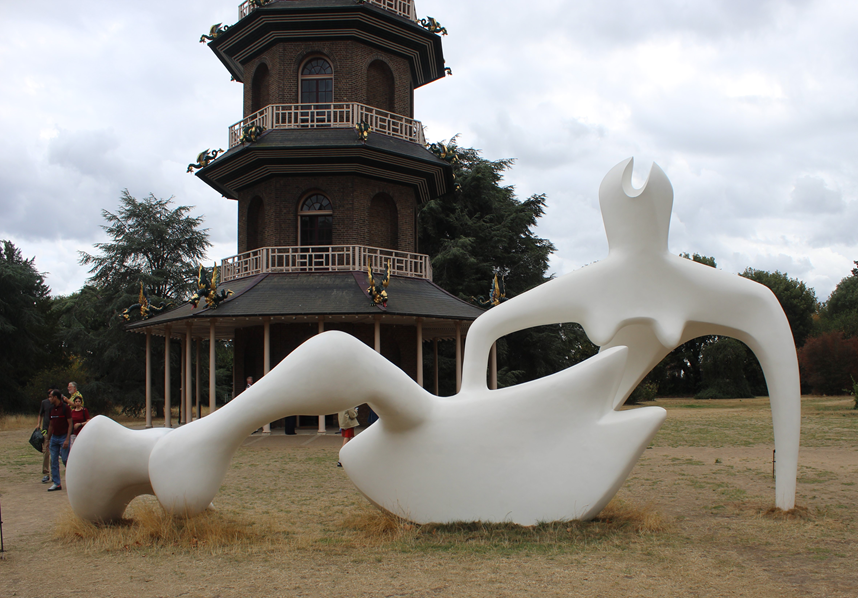
A useful independent reference is Henry Moore’s Large Reclining Figure (LH 192b), a monumental fibreglass version of Moore’s reclining-form sculpture. Wikimedia Commons documents a 1983 fibreglass version displayed at Kew Gardens in London, while the Henry Moore Foundation records Moore’s use of fibreglass among his sculptural materials. The example is useful because it shows FRP/fibreglass operating at genuine architectural scale rather than only as a small decorative prop.
How Pegasus Can Support the RFQ Stage
Pegasus presents itself as an integrated custom sculpture manufacturer working across fiberglass, stainless steel, bronze, marble and resin. Its website describes nearly two decades of manufacturing expertise, a 10,000 m² facility, 3D modeling and CNC-supported development, structural planning, multi-material fabrication, quality inspection, export packaging and international project support.
For buyers at concept stage, Pegasus states that a simple sketch or reference image can be enough to begin. For more developed projects, existing drawings and digital models can be reviewed as part of production planning. The objective at RFQ stage is therefore clarity, not perfection: provide what is known, identify what is undecided, and make the approval and delivery expectations visible.
Frequently Asked Questions
Do I need a finished 3D model before requesting a fiberglass sculpture quote?
No. Pegasus states that projects can begin from a concept sketch or reference image. If a 3D model already exists, include it and identify whether it is preliminary or approved.
Can Pegasus produce a single custom fiberglass sculpture?
Yes. Pegasus states that it accepts single custom projects depending on design and scale. Final feasibility and pricing remain project-specific.
What information has the biggest effect on a quotation?
Scale, quantity, design complexity, finish, environment, structural requirements, delivery destination, packaging, schedule and the level of design or installation support can all affect scope and cost.
Should installation information be included before manufacturing?
Yes. Site access, base/interface requirements, sectional assembly and lifting constraints can influence how a large sculpture is divided, reinforced, packed and delivered.
Can large FRP sculptures be shipped in sections?
Yes, where the project requires it. Sectioning should be coordinated with the sculpture design, packing method, transport limits and installation plan.
How long does a custom project take?
Pegasus’s FAQ states that most projects take around 45–90 days after design confirmation, depending on size and complexity. The final schedule should be confirmed for the individual project rather than treated as a universal lead time.
Ready to Request a Custom Fiberglass Sculpture Quote?
Before requesting a price, assemble the information that allows the project to be evaluated properly: intended use, dimensions, quantity, design references, finish, installation environment, destination and required schedule. If some items are still undecided, identify them clearly rather than guessing.
Explore Pegasus’s Fiberglass / FRP Sculpture Manufacturing capabilities, or contact the Pegasus team with your drawings, sketches, reference images and project brief for review.