Choose the Finish by the Job the Surface Must Do
A marble finish should not be selected by name alone. The buyer first needs to decide what the surface must do in the completed space. Should it create moving highlights, keep the form calm under changing daylight, deepen shadow in a recess or withstand close public contact without losing the intended contrast?
The practical answer follows four project conditions: light, viewing distance, contact and form. Once those conditions are clear, polished, honed, textured and mixed finishes become design tools rather than competing quality levels.
Start With Four Buyer Questions
- Light: Is the sculpture under controlled spotlights, changing daylight or several competing light sources?
- Viewing distance: Will people read the work across a lobby, approach it gradually or inspect it at arm’s length?
- Contact and care: Will visitors touch it, and can the maintenance team clean recesses and textured areas safely?
- Form: Which curves, openings or details should catch attention, and which areas should remain visually quiet?
These questions should be answered before approving a small finish sample. A sample can show color, sheen and tool marks, but it cannot reveal where a highlight will break across a concave opening or how a texture will read from the principal entrance.
A Fast Finish Selection Guide
| Project Condition | Useful Starting Direction | What the Buyer Must Verify |
| Strong controlled light and bold curves | Polished or selectively polished | Confirm where the brightest highlight appears on the full form. |
| Changing daylight or reflective surroundings | Honed or low satin | Check that the volume stays readable from morning to afternoon. |
| Broad masses or recesses that need shadow | Fine or coarse texture | View the texture at the real distance; do not approve only at close range. |
| Different zones need different visual roles | Mixed finish | Mark every boundary on a drawing and approve the transition method. |
| Frequent touch or public circulation | Honed or controlled mixed finish | Test cleaning and watch for areas that may gain sheen over time. |
What Each Finish Does to the Form
Polished Marble Creates Deliberate Highlights
Polish deepens color, strengthens veins and creates sharp reflections. It works best when those reflections support a broad curve or make an abstract form feel more dynamic. It is less suitable when glare crosses a face, inscription or subtle junction. The buyer should identify the main light source and review where the highlight lands on the developed sculpture, not only on a flat sample.
Honed Marble Keeps the Volume Calm
A honed surface diffuses light and gives broad planes a quieter, more even reading. It is often a reliable starting point for daylit atriums, residences and corporate interiors where the sculpture should remain visible without behaving like a mirror. Close-contact areas still need review because handling can gradually create local sheen.
Texture Uses Shadow Instead of Reflection
Tooling breaks light into smaller shadows. Fine texture rewards close viewing, while deeper marks can remain legible across a large interior. The specification must define direction, spacing and depth; the word “textured” alone is not enough. A texture approved from twelve inches away may disappear from the actual viewing route.
Mixed Finishes Give Different Areas Different Jobs
A polished inner curve can attract the eye through an opening while a honed exterior holds the silhouette together. A tooled recess can create depth without pigment. Mixed finishes work only when boundaries follow the geometry and are clearly mapped. Random contrast makes a sculpture look divided rather than intentional.
Match the Finish to the Space and Viewer Route
The buyer should mark the distant arrival view, the first point where openings become visible, the closest normal viewing position and any high-contact side. That route shows where reflection should attract attention, where a quieter surface should preserve mass and where texture must remain visible without becoming difficult to maintain.
| Space | Dominant Condition | Useful Direction | On Site Check |
| Daylit atrium | Changing highlights and a long approach | Honed main planes with selective polish | Review from the entrance in morning and afternoon light. |
| Hotel lobby | Warm lighting, reflective floors and close circulation | Controlled satin or honed; selective polish only | Check glare from reception and seating positions. |
| Corporate reception | Fixed approach and nearby metal or glass | Honed form with mapped accent finishes | Compare the sculpture against surrounding materials. |
| Gallery or residence | Close viewing and adjustable lighting | Fine honed or carefully mixed finish | Review transitions and tool marks at eye level. |
| Large public interior | Long sightlines and routine maintenance | Texture sized for distance with accessible cleaning zones | Confirm recesses stay legible and cleanable. |
Pegasus Project Evidence Controlling Finish Across a Curved Form
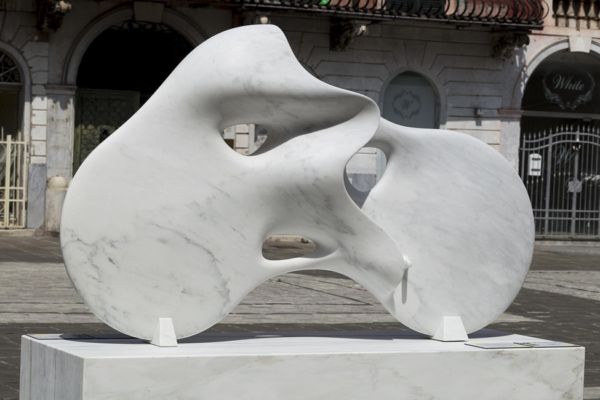
A documented Pegasus workshop project involved a large abstract marble sculpture formed by broad convex faces, deep openings and tightening curves. The manufacturing challenge was continuous visual movement. If one area reflected more sharply than the adjoining surface, or if a transition stopped abruptly, the eye would read separate patches instead of one connected form.
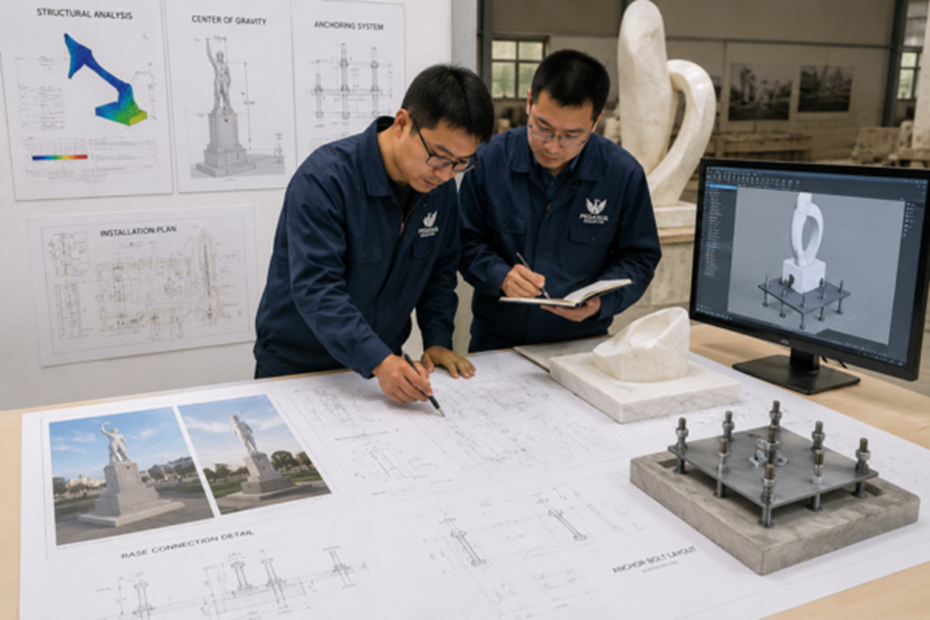
The Finish Decision
The visible objective was a softly reflective surface that would reveal the changing curves without producing isolated mirror-like highlights. Drawings and the physical model were used to identify the views where the opening, outer profile and connected planes had to remain continuous. This gave the finish a measurable visual purpose: preserve movement around the form rather than maximize gloss.
How Pegasus Controlled the Result
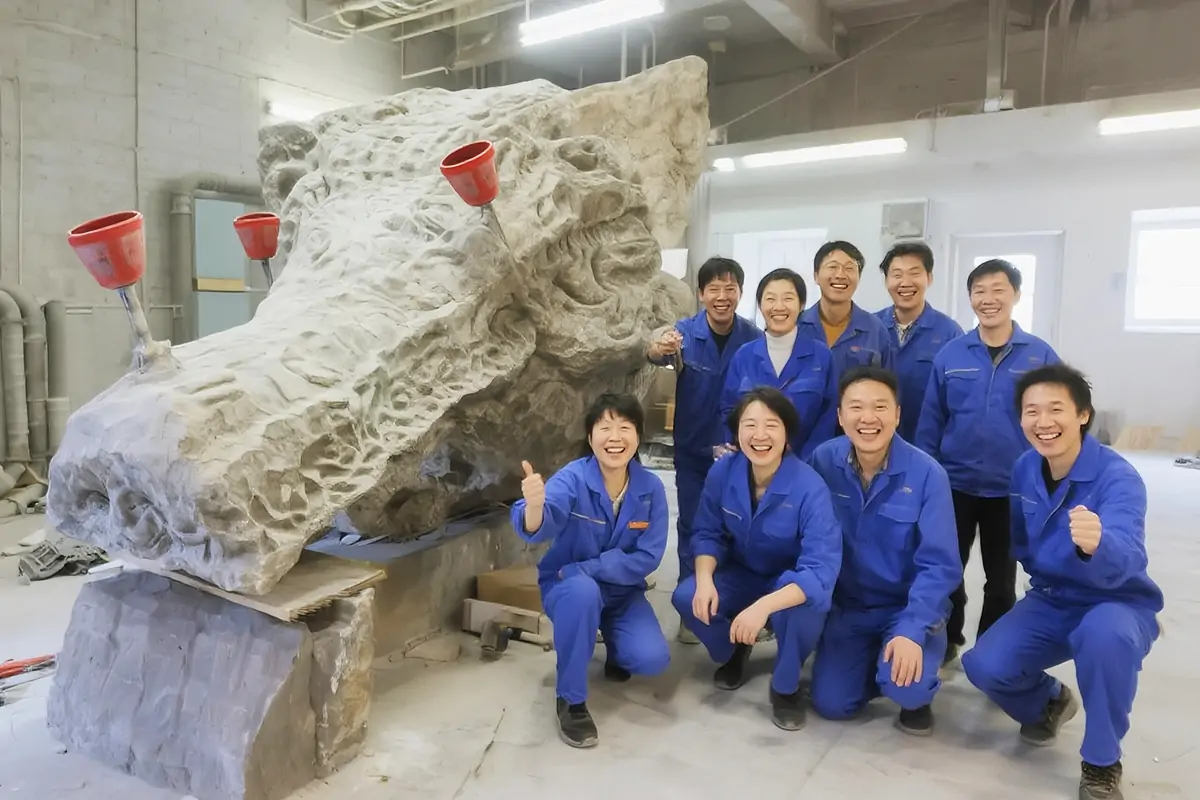
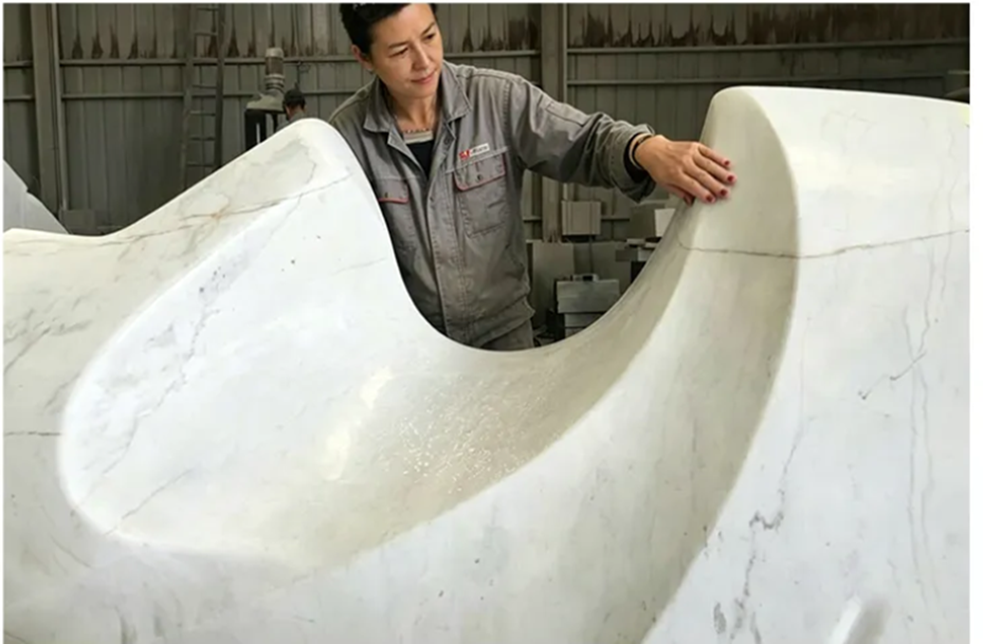
The production team reviewed the stone before detailed carving, developed the geometry through staged material removal and hand refinement, and compared finished areas directly with adjacent unfinished surfaces. This allowed the team to judge curve continuity, local sheen and the transition between connected planes while correction was still possible.
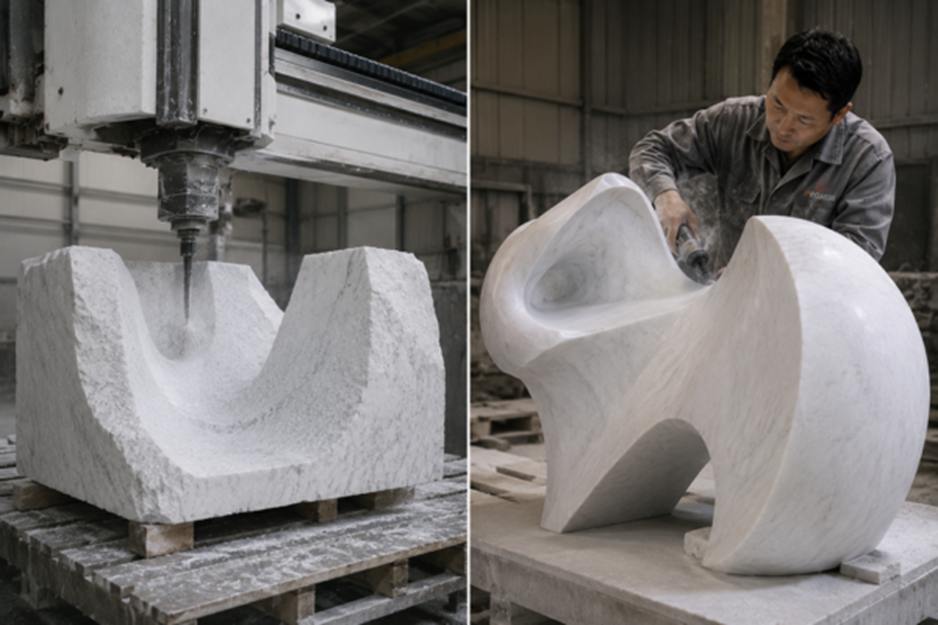
Final inspection was carried out across the full geometry rather than treating each patch as an independent sample. The completed project image shows a consistent soft reflection across the main surfaces, while the openings and profile remain legible. That visible result is the manufacturing evidence: the chosen finish supports the form instead of competing with it.
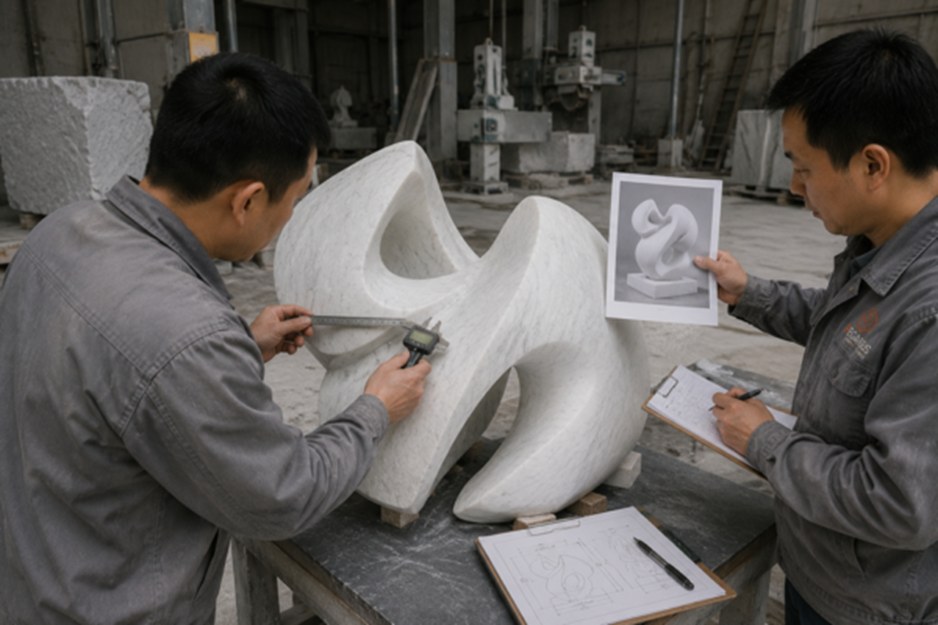
What the Buyer Should Approve Before Packing
A finish decision is ready for production when the buyer and manufacturer have agreed on the following evidence:
- A finish sample made on the proposed marble or a closely matched approved piece.
- The viewing distance and dominant light direction used to judge the surface.
- An annotated finish map showing polished, honed or textured zones and their boundaries.
- A named reference area on the sculpture for sheen or tool-mark comparison.
- Full-form photographs or video showing highlight continuity, shadow depth and transitions before packing.
This evidence keeps the approval connected to the installed appearance. It also gives the manufacturer a clear standard during hand finishing and gives the buyer something more useful than a finish name in the quotation.
Use the Simplest Finish That Solves the Visual Problem
Choose polish when a deliberate highlight should animate the form. Choose honed marble when volume must remain calm and readable under changing light. Choose texture when shadow and tactile character must remain visible. Combine finishes only when different areas need different visual roles and every boundary can be mapped and inspected.
For a custom modern marble sculpture, Pegasus can review the site images, dominant lighting, normal viewing distance, expected public contact and visual reference before preparing finish samples. This turns finish selection into a production decision that can be approved, manufactured and checked.
Review Pegasus marble sculpture manufacturing capabilities | Share a project for finish review
Common Buyer Questions
Is a small finish sample enough for approval
It is useful for comparing sheen, color and tool marks, but it cannot predict how light will move across a large concave or convex form. Review the approved treatment on a representative curved area and then across the completed geometry.
Can polished marble work in a high traffic interior
Yes, when reflections are controlled and the cleaning plan suits the stone. Buyers should check fingerprints, likely touch zones and glare from nearby floors, windows and fixtures before approving a full polish.
When is a mixed finish better than one finish
Use a mixed finish when separate parts of the sculpture need different visual roles, such as a reflective inner curve and a quieter outer mass. The finish map and transition boundaries must be approved before final surface work.