The Architectural Idea Is Only the Beginning
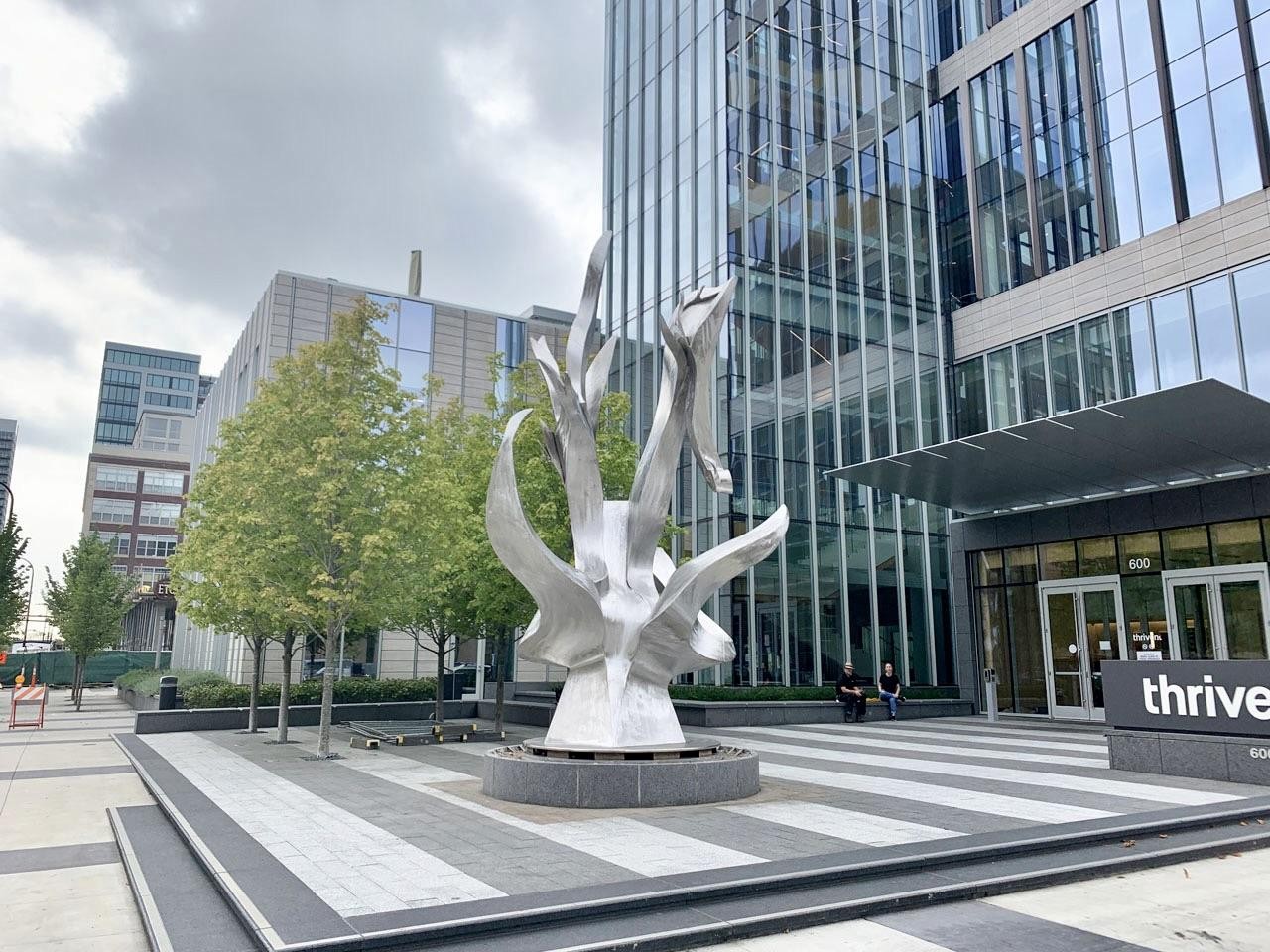
A curtain-wall façade may have hundreds of repeated mullions, reflective panels and precise junctions. A sculpture placed beside it needs more than a pleasing rendering: the curves must be formed at full scale, the surface must read clearly against glazing and fabrication joints must not disrupt the intended silhouette. Buyers evaluating abstract sculptures should therefore ask how the chosen form will be made, not only how it will look.
Pegasus can support the transition from an architect-approved concept to a manufacturable proposal through modeling, material discussions and sculpture fabrication. The architect remains responsible for the design intent; the factory’s value is identifying where production methods could change what the buyer sees.
1. A Calm Form Against a Busy Façade: What Can Actually Be Formed?
Buyer problem: A fluid loop looks like an effective counterpoint to a rigid glass grid, but the rendering hides tight turns, compound curves and areas where separate metal surfaces intersect. A shape that looks continuous on screen may need multiple formed components in the workshop.
Manufacturing response: Rather than simply proposing a different design, Pegasus can examine the approved 3D geometry for achievable curvature, access for forming and welding, and areas that may require separate panels. For stainless steel, the method used to shape each component affects how closely the finished object follows the original profile. The useful review is a model annotated with any radius, junction or panel changes that would alter the visible line.
What the buyer should see: a before-and-after comparison of the critical curve against the building elevation, so a manufacturing adjustment does not accidentally introduce the visual complexity the architect was trying to avoid.

2. Scale Without Visual Heaviness: How Construction Changes the Appearance
Buyer problem: A sculpture that appears light in a small render can feel bulky beside a lobby once enlarged. Conversely, an extremely thin edge may be visually elegant but impractical for the intended material, span or internal construction.
Manufacturing response: Pegasus can compare fabrication approaches that produce the intended volume and edge profile. A hollow fabricated metal form, a cast component and a fiberglass-based form involve different wall construction, surface treatment and assembly considerations. The appropriate route depends on the actual geometry, exposure and required finish; material choice should not be decided from the rendering alone.
Ask for a dimensioned section through the most visually sensitive area, showing the proposed outer profile and any construction allowances. The buyer can then decide whether the sculpture will still look proportionate against the glazing, columns and canopy. Site engineering and structural sign-off remain separately assigned project responsibilities.
3. Reflective Glass Changes the Finish: Test the Actual Surface
Buyer problem: A mirror-polished sculpture can reflect the façade so strongly that its outline becomes difficult to read. A brushed surface may provide a steadier visual edge, while bronze can create a warmer material contrast. These are appearance decisions with manufacturing consequences, not simply color selections.
Manufacturing response: On stainless steel sculptures, forming, weld blending and polishing influence how uniformly the surface reflects light. For bronze sculpture, casting and patination create a different range of surface characteristics. A sample made on a representative curved piece is more useful than a flat finish swatch because the curvature changes the reflection.
Request side-by-side finish samples against the actual façade material, viewed from the main approach distance. Ask how weld transitions, grain direction, fingerprints and cleaning will affect the chosen appearance over time.

4. A Seamless Silhouette Needs a Joint Strategy Before Fabrication
Buyer problem: A continuous ribbon may need several fabricated panels. If the seams fall across the strongest visible curve, the sculpture can appear segmented even when its overall dimensions are correct.
Manufacturing response: Pegasus can review where components meet, which surfaces allow welding access and how much finishing is possible around a tight opening. This is not a general shipping discussion: the central issue is whether the proposed joint layout preserves the silhouette and surface rhythm against the building.
Ask the manufacturer to show planned seams on the approved 3D model and identify the joints visible from the entrance. Where a joint must remain visible, the design team can approve its location intentionally. Where it must disappear, the factory should explain the proposed finishing approach and its practical limits.

5. The Curve Looks Perfect Digitally: Which Details Need a Physical Test?
Buyer problem: A digital model may not reveal how a sharp return, narrow gap or highly polished welded area will look after forming and finishing. Small differences become conspicuous beside the precise edges of a glass façade.
Manufacturing response: A targeted prototype or representative detail sample can test the hardest feature before the entire sculpture is fabricated. For example, a curved sample may help the buyer evaluate edge thickness, the finish across a weld and the transition between two surfaces. A full sculpture prototype is not always necessary; the most useful sample reproduces the detail that carries the greatest visual risk.
Ask Pegasus which single detail is most likely to affect the approved appearance and what sample or drawing would settle that uncertainty. Record the agreed result as the visual reference for production.
6. Factory Review: Does the Finished Object Still Match the Building?
Buyer problem: A sculpture can meet its dimensions yet lose the quality that made the architect select it: a clean outer contour, consistent finish or controlled relationship to the façade.
Manufacturing response: Agree on appearance-focused checks that are specific to the work: silhouette from named viewpoints, edge alignment at fabricated junctions, continuity of the surface finish and comparison with the approved curved sample. Where practical, workshop assembly photographs or inspection views can show these characteristics before dispatch.
This review is different from a general project approval checklist. It asks whether the fabricated object still achieves the intended architectural relationship. Structural calculations, foundation design, site access and installation permissions remain with the designated professionals and contractors.
Manufacturing Questions Worth Asking Pegasus
| Architectural concern | Fabrication question | Useful evidence |
| Clean curve against a busy grid | Where will the form need separate formed panels? | Marked-up 3D geometry and key elevation views |
| Light-looking edge | What thickness or construction will be visible? | Dimensioned cross-section / detail sample |
| Legible surface beside reflective glass | How will finish and weld blending affect reflections? | Representative curved finish sample |
| Unbroken silhouette | Where will joints appear from the main entrance? | Joint map and workshop inspection views |
A Manufacturing Example: What the Evidence Can—and Cannot—Show
Pegasus has published a description of a custom metal sculpture for a mixed-use development that discusses internal framework planning, fabrication in transportable sections, welding, trial assembly and finishing. It is relevant here because decisions about sectioning and assembly can influence the continuity of the finished form. However, the published account does not establish that the sculpture was commissioned for a glass-and-steel façade or provide a verified matching design-to-finished photographic sequence. It should therefore be read as an example of manufacturing planning—not proof of a specific architectural integration outcome.
For background on the reported fabrication approach, see Pegasus’s custom metal sculpture fabrication article.
Frequently Asked Questions
Does a polished finish always suit a glass façade?
No. Reflective metal can visually merge with reflective glazing. Compare a curved finish sample against the actual façade material before selecting the surface.
Can a continuous-looking abstract sculpture be made in sections?
Often, depending on its geometry and fabrication method. Joint positions and finishing access should be evaluated early so the final silhouette remains coherent.
What is the most useful manufacturing review for an early design?
A review that identifies specific visible risks—such as tight radii, thin edges, panel junctions or finish transitions—and provides drawings or samples that allow the design team to decide.
Does Pegasus replace the project architect or structural engineer?
No. Pegasus can contribute fabrication and manufacturing information. Artistic approval and site-specific engineering responsibilities must be assigned under the commission.
Discuss a Sculpture That Works With Your Building
Share your façade elevation, proposed sculpture concept and the views that matter most. Pegasus can discuss how the form, fabrication method and surface finish may be developed without losing the architectural intent. Explore the custom sculpture development process or contact Pegasus about your project.