The Approval Problem Is Not “Do We Like the Render?”
Once an abstract form has been selected, the next commercial decision is whether that design is ready to become a physical sculpture. A single hero rendering is not enough. The form must still read from the entrance, across the pedestrian route, from close range and—where relevant—from upper floors or glazing.
For Pegasus, design sign-off is the bridge between concept and fabrication. The approved visual logic needs to survive the move from a digital model into full-scale material, structure, curved panels, joints, surface finishing and the visible base relationship. That is why the sign-off set should establish what must remain visually true before production begins.
Pegasus capability link: Custom Abstract Sculptures | Custom Sculpture Manufacturing & Engineering
1. Lock the Views That Actually Define the Sculpture
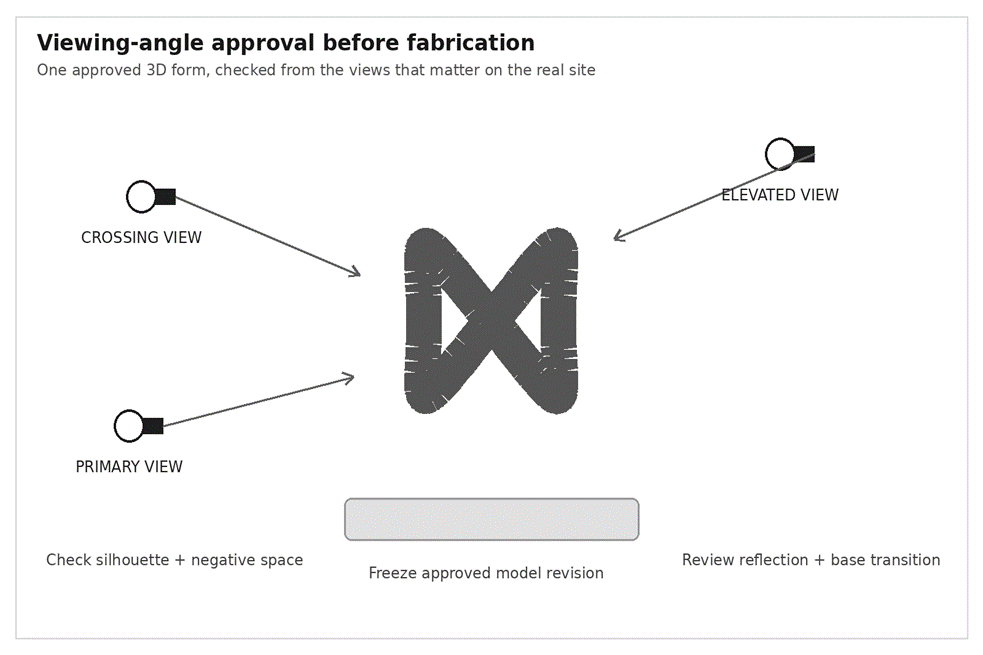
The strongest sign-off process begins by naming the views that matter. A corporate plaza may have a fast arrival view and a slower pedestrian view. An atrium may be read from the ground floor, escalator and upper balcony. A courtyard may be framed through glazing before visitors enter the space.
| View | Design question | Sign-off evidence | Pegasus response |
| Arrival view | Does the form read clearly at the first meaningful distance? | Site-based rendering from the real approach height and direction. | Pegasus can place the approved 3D form into agreed camera views so the same geometry is reviewed consistently. |
| Crossing view | Does the form develop as people move past it? | Short turntable or walk-through sequence. | A 3D model can be reviewed through a controlled sequence rather than relying on one attractive still image. |
| Pause view | Do voids, edges and transitions remain intentional close up? | Detailed views from likely stopping points. | Production-facing geometry can be checked against the approved close-range reading before fabrication. |
| Elevated view | Does the top/reverse side remain resolved? | Views from balconies, bridges or upper glazing. | The same digital model can expose surfaces and relationships that a ground-level hero view hides. |
The purpose is not to make every angle identical. It is to define a primary composition, the secondary views that must remain resolved, and any rear/service view that is intentionally less important.
2. Approve Silhouette and Negative Space as One Composition
In an abstract sculpture, the empty space is part of the object. A loop that frames an entrance from one direction may visually close against a dark facade from another. Two separated forms may appear to touch from the main path. A narrow opening that works in a desktop model can disappear when the sculpture is enlarged and viewed from farther away.
Pegasus’s published workflow uses Rhino and ZBrush for digital 3D development. At sign-off, that model can be used to compare the outer silhouette and principal voids from the agreed camera positions before the geometry is released to engineering and fabrication. This is more useful than approving an isolated perspective that does not correspond to the real site.
3. Treat Reflection as Geometry, Not Decoration
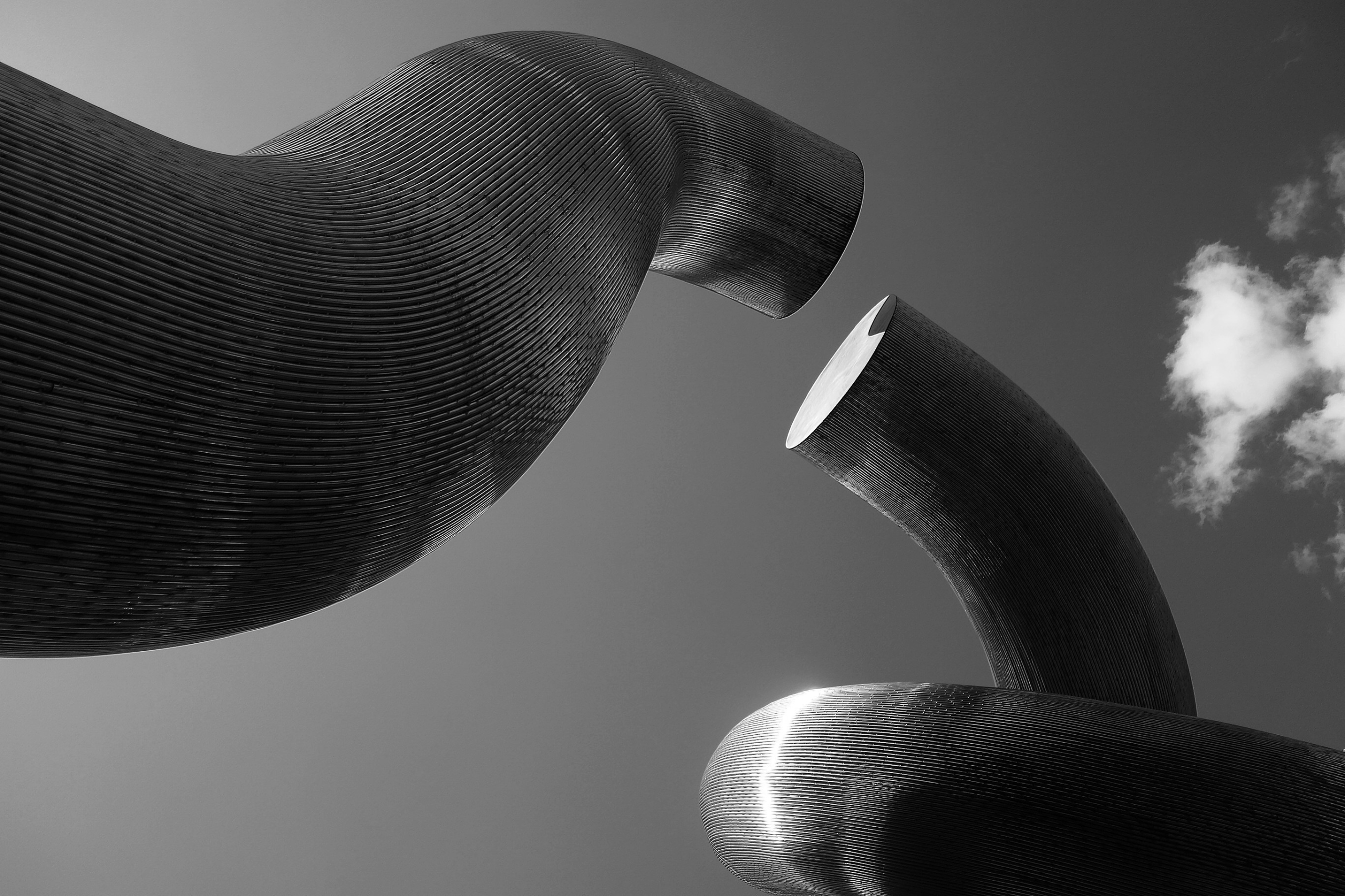
On polished stainless steel, reflection changes the perceived volume. A broad convex panel stretches surrounding architecture; a tighter concave transition compresses reflected lines; a small surface irregularity can become much more visible once the panel is mirror polished. The design decision therefore comes before the final polishing inspection: is the approved curvature creating the intended visual behaviour?
Pegasus publishes a digital 3D prototyping workflow using Rhino and ZBrush, followed by hand-forming, welding and multi-stage surface finishing for stainless steel sculpture. That allows the project team to review the form digitally before steel is cut and then preserve the approved geometry through production. For projects where reflection is critical, the quotation can define an additional reflection-study or representative curved-surface sample as an approval deliverable rather than assuming a flat finish sample will answer the question.
What Pegasus can confirm before fabrication
- Agreed camera positions and the 3D geometry used for those views.
- The silhouette and principal negative spaces that must remain visually open.
- Whether reflective curvature needs an additional digital study or representative curved sample within the project scope.
- Which design surfaces and transitions are visually critical when the form is translated into fabricated panels.
- The revision of the approved 3D model that becomes the reference for engineering and production.
Related manufacturing process: Stainless Steel Sculpture: From Concept to Installation
4. Keep the Base Transition Inside the Approved Form
A base can change the sculpture more than expected. A heavy plinth can close a lower void, a visible fixing zone can interrupt a clean silhouette, and a paving joint can create an unintended line through the composition. The visible base relationship therefore belongs in design sign-off even though the local foundation and structural design may continue separately.
Pegasus can carry the approved base relationship into production-facing drawings and the sculpture-side interface. The sign-off set should show whether the sculpture appears to rise directly from paving, sit on a visible plinth, meet a landscape bed or use a deliberate shadow gap. This gives engineering a visual condition to preserve instead of asking the workshop to interpret the base after the form has already been approved.
5. How Pegasus Turns an Approved Form Into a Fabrication Reference
This is where design sign-off becomes manufacturer value. The approved views are not only presentation images; they become a visual control for the production model. Pegasus’s published capabilities combine 3D modelling, structural engineering, precision fabrication and surface finishing under one manufacturing workflow. The practical objective is to keep the sculpture recognisable as the approved design while the team resolves the hidden engineering needed to manufacture it.
| Approved decision | Pegasus manufacturing response | Why it matters |
| Approved 3D form | Freeze the correct model revision before fabrication planning. | Prevents production from following an earlier or superseded concept. |
| Key sightlines | Keep the agreed camera views attached to the design record. | Provides a visual check when geometry is refined for production. |
| Curved reflective surfaces | Review digital geometry; define a curved sample/reflection study if the project requires it. | Connects mirror-finish behaviour to the actual curvature rather than a flat sample alone. |
| Complex full-scale geometry | Translate the digital model into production-ready geometry; Pegasus also publishes CNC capability for complex forms/moulds. | Supports dimensional fidelity as the design moves from screen to workshop. |
| Base transition | Coordinate the visible sculpture-side interface with the approved visual relationship. | Protects the lower composition while structural/site details are resolved. |
| Fabrication release | Use the approved revision as the reference before cutting/forming begins. | Creates a clearer boundary between design approval and production changes. |
A Manufacturing Example: When Surface Behaviour Depends on the Form
Pegasus’s published stainless-steel manufacturing material describes a recent metal sculpture project in which the team used repeated manual surface levelling and precision spray finishing to achieve controlled light-and-shadow behaviour across large sculptural surfaces. The useful lesson for design sign-off is not the colour itself: the approved visual effect depends on both geometry and the production route used to reproduce it.
For an abstract project with polished or high-gloss surfaces, the same principle applies. The project team should approve the geometry that creates the visual effect, while Pegasus defines how that approved geometry moves through modelling, forming, joining and finishing. The exact sample, prototype or reflection-study scope should be written into the project quotation.
Source: Pegasus stainless steel fabrication workflow
The Design Sign-Off Set Pegasus Can Work From
A useful approval set should be compact enough to control the decision and specific enough to become a production reference. For most commercial abstract sculpture projects, the following is a workable starting point:
- Site plan marking the primary and secondary viewing positions.
- Matched renderings from those exact camera positions using the current architectural or landscape background.
- Monochrome silhouette views showing the outer profile and critical negative spaces.
- A movement sequence where the sculpture is experienced while walking or driving past it.
- A reflection study or representative curved-surface approval item when polished curvature materially changes the reading.
- A close view of the visible base transition and its relationship with paving, plinth or landscape.
- One clearly identified 3D model revision that becomes the visual reference for production.
Each item should carry a view name or revision reference. Once the design is signed off, later engineering or production adjustments that materially change an approved silhouette, void, reflective curve or base relationship should be returned for design review rather than being absorbed silently into fabrication.
Ready to Sign Off an Abstract Sculpture Design?
Send Pegasus the current 3D model or concept, site plan, target dimensions, architectural/landscape background and the viewing positions that matter most. Pegasus can use those inputs to structure the design-confirmation stage and identify which visual decisions need to be locked before the sculpture moves into production engineering and fabrication.
Discuss the project with Pegasus | Review Pegasus abstract sculpture capabilities
Frequently Asked Questions
What should be frozen at design sign-off before fabrication starts?
The approved model revision, primary/secondary views, critical silhouette and void relationships, reflective curvature where relevant, and the visible base relationship. Engineering can continue, but a change that materially alters one of those visual conditions should return to design review.
Can Pegasus work from a concept rather than finished technical drawings?
Yes. Pegasus states that projects can begin from sketches or reference images and be developed into production-ready 3D models. For this article’s stage, the important point is identifying the model revision and views that will become the approval basis.
How can a buyer review a mirror-polished curved surface before full fabrication?
A flat finish sample confirms gloss and surface quality but not the way a curved form reflects its surroundings. Where reflection is critical, the project scope can include digital review of the 3D curvature and, when appropriate, a representative curved-surface sample or prototype.
Does design sign-off replace structural engineering?
No. Design sign-off establishes the visual conditions that the finished sculpture must preserve. Structural calculations, internal framing and site interfaces are separate engineering tasks that must support—not silently change—the approved form.