A branded sculpture is not successful simply because its shape matches the approved rendering. In a hotel lobby, flagship store, shopping mall or themed attraction, the finished work becomes part of the customer experience. Its color must remain recognizable under the site lighting, its surface must tolerate the expected level of contact and cleaning, and its material documentation must match whatever the project team and local authority require for that location.
This is where fiberglass-reinforced plastic, commonly called FRP, needs to be specified as a system rather than treated as a generic material. The resin, reinforcement, coating, internal support, connection details and maintenance plan work together. A sculpture designed for a protected reception area may need a different specification from the same form placed beside a sunlit storefront, beneath an atrium skylight or within a high-contact family attraction.
This guide focuses on those commercial-space decisions. For the separate list of drawings, dimensions, quantities, site details and delivery information needed to request a quotation, refer to Blog 7, “Custom Fiberglass Sculpture RFQ: What Buyers Should Specify Before Requesting a Quote.”
Define the Brand Experience and Exposure Zone
The first decision is not “Which fiberglass should we buy?” It is “What must this installation do in this exact location?” A branded object may function as an arrival landmark, a photo moment, a character encounter, a navigation cue or a repeating display across several properties. Each role changes what the team should approve.
Map the sculpture to a specific exposure zone. A fully conditioned interior generally faces less weathering than a storefront window receiving daily sunlight. A covered entrance may still experience wind-driven rain and temperature changes. An atrium below glazing can receive substantial daylight, while a theme-park queue may involve frequent touching, leaning and cleaning.
- Visual role: landmark, mascot, art feature, photo point, campaign display or repeated brand element
- Exposure: conditioned interior, sunlit interior, covered exterior or full exterior
- Interaction: viewed only, occasional touch, frequent contact or supervised climbing prohibition
- Operational conditions: cleaning schedule, nearby food service, carts, luggage, strollers or queue barriers
Defining the zone prevents a common specification error: applying one standard finish and laminate assumption to every commercial location.
Project Evidence From a Pegasus FRP Installation
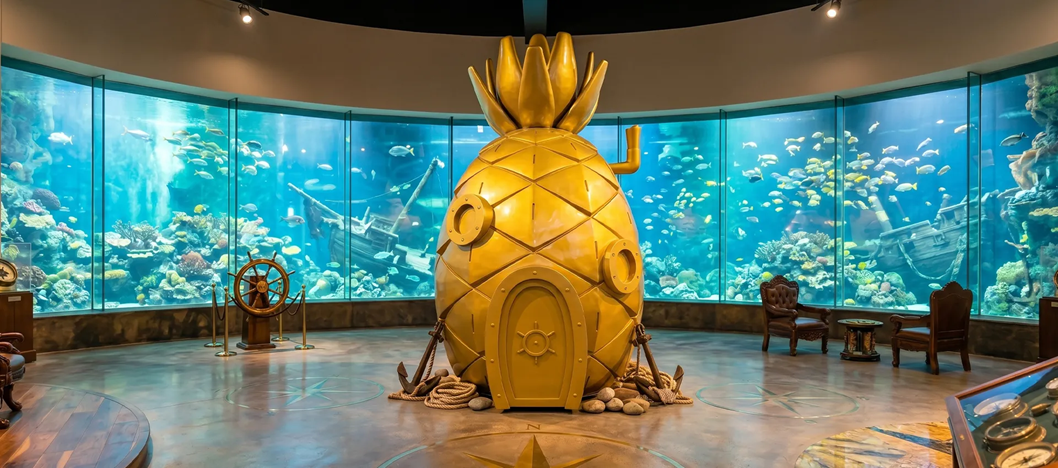
Pegasus identifies this visitor-facing centerpiece as a large-scale FRP project installed in the central atrium of the Wonder Art Center. The published image shows why commercial-space decisions matter: the saturated gold finish is viewed under strong ambient lighting, against reflective glazing, and within an area intended for close public viewing. The installed result addresses that setting with a bold, self-contained form and a high-contrast finish that remains legible within a visually complex interior.
The public project record confirms the project, client, location and FRP category, but it does not publish the coating build, fire-test basis or installation method. Those details are therefore not claimed here. For a new branded installation, the same project-specific items should be documented and approved rather than inferred from a portfolio photograph.
Control UV Exposure Through the Complete Finish System
“Indoor” does not automatically mean “no UV exposure.” Sculpture placed beside large glazing, under an atrium roof or in a storefront window can receive repeated daylight. Outdoors, orientation, latitude, shade, heat and moisture add further variables. The practical concern for a branded installation is not only structural survival; it is whether color, gloss and surface appearance remain acceptable for the planned service period.
The project team should identify which visible changes would be unacceptable: fading of a signature color, yellowing of a clear coat, chalking, loss of gloss, cracking around joints or visible repair patches. The manufacturer can then propose a compatible resin, primer, color coat and protective topcoat system for review.
Where durability evidence is important, ask what accelerated-weathering method, exposure duration, substrate and coating build were used. ASTM G154 is one commonly referenced practice for fluorescent ultraviolet exposure of nonmetallic materials, but a test reference alone is not a lifetime guarantee. Results are meaningful only when the tested build represents the proposed sculpture system and the project team understands the acceptance criteria.
- Record the approved color reference and the physical sample that controls production.
- Define whether color shift, gloss loss, chalking or cracking will be evaluated.
- Confirm that repair paint and touch-up procedures are available for the installed location.
- For multi-site programs, retain an approved master sample for later production batches.
Resolve Fire Performance Evidence Before Material Selection
For an indoor commercial project, “fire-retardant resin” should not be treated as a complete compliance statement. The applicable requirement can depend on how the object is classified, its size and location, whether it is fixed or temporary, nearby exits and the rules adopted by the local jurisdiction. The architect, fire consultant and authority having jurisdiction should determine what evidence is required.
The buyer should ask for the exact test report or certificate, the tested material build, the issuing laboratory, the standard and edition used, and confirmation that the proposed resin, reinforcement, coating and thickness correspond to the tested system. Substituting a different topcoat or laminate after approval can make the submitted evidence less representative.
ASTM E84 and NFPA 286 are examples of standards that may appear in U.S. interior-finish discussions, but they address different test configurations and should not be presented as interchangeable. The project specification—not the manufacturer’s marketing language—must identify the evidence appropriate to the intended installation.
- Do not describe FRP generally as fireproof.
- Do not accept a certificate that identifies only a resin trade name without linking it to the proposed construction.
- Confirm whether coatings, adhesives, internal foam or other components are included in the reviewed assembly.
- Obtain approval before production, not after the sculpture has been completed.
Approve the Finish Under Real Viewing Conditions
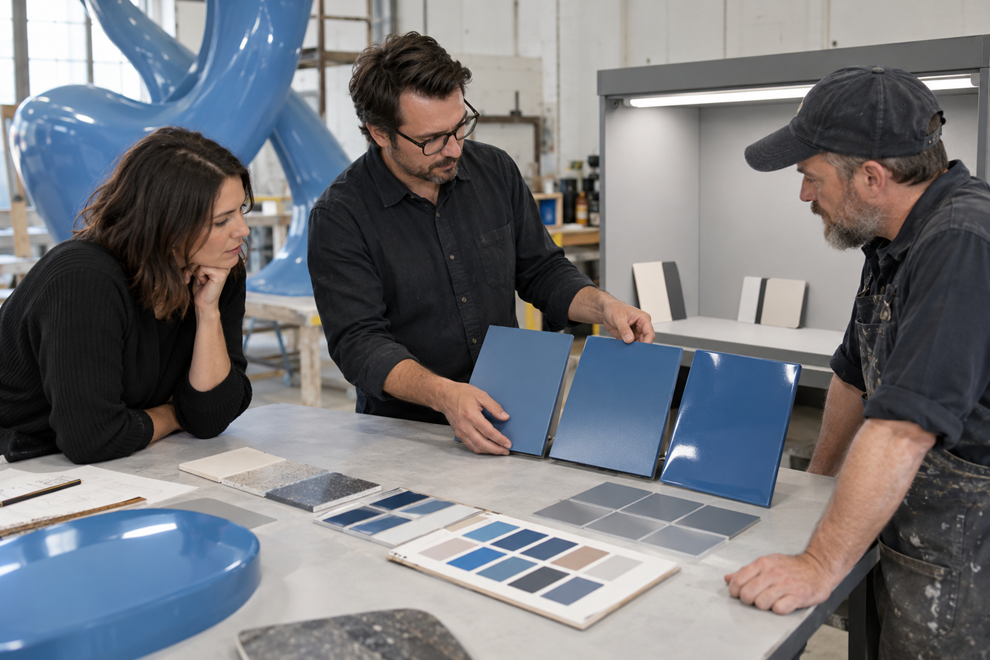
Brand colors are especially sensitive on curved forms. The same paint can appear lighter on a convex surface, darker in a recess and different again under warm hotel lighting or cool retail LEDs. A digital rendering is useful for design coordination, but it should not be the final color-control document.
Use a physical approval sample made on a representative substrate with the proposed primer, color and clear-coat build. The sample should be large enough to show texture and gloss, and it should be reviewed under lighting that resembles the installation. For metallic-effect, pearlescent or translucent finishes, orientation and spray technique can also affect the appearance.
| Approval Item | What to Record | Why It Matters |
| Color | Reference code plus signed physical sample | Screens and printers cannot reliably control final color. |
| Gloss | Matte, satin or gloss sample; measured value if the project requires it | Gloss changes perceived color and makes surface waves more or less visible. |
| Texture | Smoothness, intentional texture and acceptable repair boundary | Prevents subjective inspection after production. |
| Multi-color edges | Masking line, transition quality and tolerance at details | Important for mascots, logos and graphic forms. |
| Lighting review | Daylight, display lighting and night condition as relevant | A finish can pass in the workshop but look different on site. |
Design for Public Contact and Cleaning Operations
A sculpture in a roped-off lobby zone is used differently from a mascot placed beside a family queue or a retail photo point. High-contact installations need deliberate decisions about projecting details, sharp transitions, accessible cavities, base edges and areas likely to receive repeated hand contact.
The design team should identify expected touch zones during concept review. These areas may benefit from smoother geometry, additional local reinforcement, a finish selected for repeated cleaning and a repair method that does not create obvious color patches. The facility team should also approve cleaning products before opening, because aggressive solvents or abrasive pads can alter gloss and damage coatings.
Public-contact planning does not replace a project-specific safety review. It gives the manufacturer and project team a realistic use case so that detailing, support and finish decisions can be coordinated early.
Govern Multi-Location Rollouts With a Master-Control System
Retail groups, hotel brands and entertainment operators may need the same character or sculptural form in multiple locations. In that case, consistency becomes a production requirement rather than a general quality preference.
A controlled master model and mold can help maintain geometry across units, but the approval system must also control color, gloss, graphics, orientation and base details. Numbered units, retained samples, batch records and the same inspection photography can make later comparisons more reliable. If a second production run is likely, the project should also define who owns and stores the master and molds, how long they will be retained and what changes require a new approval.
- Approve one reference unit or clearly defined first-article sample before the full run.
- Use the same camera angle and neutral lighting for visual inspection of each unit.
- Record approved deviations for hand-finished details rather than expecting impossible visual identity.
- Maintain repair colors and finish instructions for each destination.
Protect the Approved Brand Finish During Site Integration
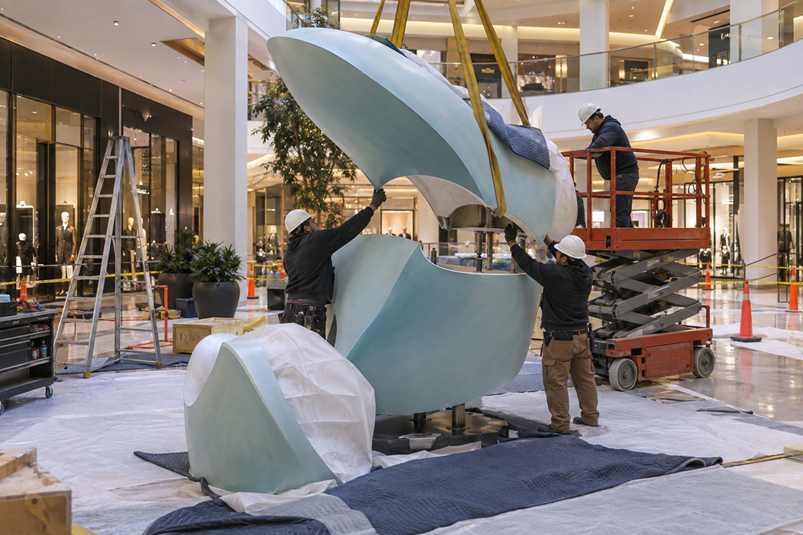
Blog 7 covers the access information required at RFQ stage. Here, the narrower concern is brand-finish control during site integration: keeping the approved color, gloss, graphic edges and visible joints intact while the sculpture moves through an operating commercial property and is fixed in place.
Translate the approved appearance standard into a site method. Confirm where protective wrapping is removed, which surfaces may carry lifting loads, how visible joints will be closed under the actual lighting and who has authority to accept the final touch-up. If sectional construction is required, locate connections where technicians can complete the finish without leaving conspicuous seams in principal viewing angles.
Operating malls and hotels may allow only a short overnight work window. A rehearsed sequence, prepared connection hardware, controlled unpacking area and named finish-acceptance representative reduce the risk that site pressure overrides the approved visual standard.
Give Facilities Teams an Appearance-Control Standard
The handover package should convert the approved appearance into an operating standard for brand and facilities teams. It should identify approved cleaning methods, prohibited chemicals, inspection points, touch-up materials, acceptable repair boundaries and the person responsible for approving visible repairs.
The operating standard should match the guest experience. A protected corporate lobby may focus on dust and lighting-visible marks; a retail photo point may require frequent fingerprint removal and close review of base edges; a sunlit display should track color and gloss against the retained master sample. This is appearance governance, not a generic maintenance schedule.
Create a handover image set from fixed camera positions under normal site lighting and retain the signed finish sample. Together, they give the owner an objective baseline for distinguishing routine wear, impact damage and an unacceptable color or gloss change after repair.
Commercial Performance Approval Gate
Before releasing an FRP sculpture for production, the project team should close the following performance decisions. This approval gate is intentionally separate from Blog 7, which assembles the commercial and logistical inputs needed to request a quotation.
| Decision Area | Project Team Should Confirm |
| Brand role | The sculpture’s purpose, intended viewing angles and whether it must work as a photo point or repeatable brand asset. |
| Exposure zone | Conditioned interior, sunlit interior, covered exterior or full exterior, including expected moisture and temperature conditions. |
| UV and coating | Approved coating build, physical color sample, expected appearance criteria and relevant weathering evidence. |
| Fire documentation | The requirement set by the design team or authority, plus reports that represent the proposed assembly. |
| Public interaction | Expected touch level, protected zones, detail risks, cleaning frequency and repair approach. |
| Finish control | Color, gloss, texture, transition quality, sample size and site-lighting review. |
| Repeat production | Master/mold control, first-article approval, retained samples and unit-to-unit inspection method. |
| Installation protection | Access route, section joints, lifting points, protection, work window and final touch-up responsibility. |
| Handover | Cleaning instructions, prohibited products, inspection schedule, touch-up materials and baseline photographs. |
Frequently Asked Questions
Are all FRP sculptures suitable for indoor commercial spaces?
No single FRP specification is automatically suitable for every commercial interior. The required material documentation, surface system, support and public-contact detailing depend on the location and the project team’s requirements.
Does an indoor sculpture need UV protection?
It may. Installations near windows, storefront glazing or atrium roofs can receive repeated daylight. The exposure should be reviewed rather than assuming that every indoor location has negligible UV.
Is fire-retardant resin enough to demonstrate compliance?
Not by itself. The project team should define the required standard and documentation, then verify that the tested construction represents the proposed resin, reinforcement, coating and thickness. Approval rests with the relevant design professionals and authority having jurisdiction.
How should a brand color be approved?
Use a signed physical sample produced with the proposed coating build and review it under representative lighting. A digital color value can support coordination but should not be the only acceptance reference for a sculptural surface.
How is this article different from the fiberglass RFQ guide?
This article defines what the installed sculpture needs to achieve in a branded environment. Blog 7 explains what drawings, dimensions, quantities, site information and commercial inputs a buyer should send when requesting a quotation.
Planning an FRP Sculpture for a Branded Environment
A successful commercial FRP sculpture connects brand intent with measurable approval criteria. Exposure, fire-performance documentation, finish samples, public contact, repeatability, installation protection and maintenance should be resolved as project requirements—not left as assumptions hidden inside the word “fiberglass.”
Pegasus develops custom FRP and fiberglass sculptures for commercial environments. Review the Fiberglass and FRP sculpture capabilities and use the project contact process to discuss the intended location, approved design and required technical documentation.