A sample resin ornament may look impressive when viewed on its own. The real test begins when the same design must be reproduced across hundreds or thousands of units without losing its proportions, surface detail, colour, finish, stability, or presentation quality.
That distinction is important for brands, wholesalers, interior-accessory suppliers, licensed merchandise companies, hospitality procurement teams, artists, galleries, and commercial developers. These buyers are not simply ordering an individual resin statue. They are investing in a repeatable production system that must protect the design from the approved prototype through to the final packaged shipment.
The right supplier therefore cannot be selected by comparing finished product photographs alone. Successful bulk production depends on whether the manufacturer can translate the original design into suitable tooling, establish a reliable reference sample, control variation across different batches, manage finishing at scale, protect intellectual property, and develop packaging appropriate for international distribution.
This distinction becomes even more important when the project involves repeat orders, brand consistency, export packaging, and commercial delivery schedules. A reliable manufacturing partner is expected to manage the complete production programme—from prototype approval and tooling to quality control, packaging, and shipment—not simply produce individual resin castings.
At Pegasus, every bulk resin project is managed as one connected manufacturing programme rather than a series of independent workshop activities. From the initial design review and prototype development to mould engineering, casting, finishing, quality inspection, packaging, and international delivery, every stage follows the same approved production standard. This integrated workflow helps commercial buyers achieve consistent quality, controlled production, and reliable repeat orders without compromising the original design.
This guide explains what buyers should examine when selecting a partner for the bulk manufacture of custom resin ornaments, statues, figurines, and decorative collections.
Bulk Production Is a Repeatability Challenge, Not Simply a Quantity Challenge
Increasing an order from one prototype to 500 finished pieces is not a matter of repeating the same casting step 500 times.
Each additional unit introduces opportunities for variation:
- Moulds can gradually lose definition.
- Resin ratios can change between production batches.
- Trapped air can produce bubbles or incomplete details.
- Curing conditions can affect dimensions and stability.
- Manually applied colours can drift between operators.
- Thin components may deform or break during handling.
- Multi-part pieces may no longer align consistently.
- Packaging that protects one sample may fail during palletised transport.
A serious manufacturer must anticipate these risks before mass production begins.
This requires the production team to understand not only how the piece should look, but also how it will be moulded, divided, cast, assembled, finished, inspected, packed, and shipped repeatedly.
At Pegasus, repeatability is planned from the beginning of every project rather than inspected only after production starts. Before mass manufacturing begins, the engineering, mould-making, casting, finishing, and quality-control teams work from the same approved production standard. This coordinated workflow helps maintain consistent dimensions, surface quality, colour accuracy, and assembly throughout the production run. Rather than focusing only on producing an attractive prototype, Pegasus builds a manufacturing system capable of reproducing that approved standard across every commercial batch.
For buyers, the central supplier-selection question should therefore be:
Can this manufacturer repeatedly deliver the approved commercial standard throughout the complete order?
Production capacity matters, but controlled repeatability matters more.
Start by Defining the Commercial Purpose of the Collection
Before evaluating moulds, machinery, or workshop capacity, the buyer and manufacturer should establish what the collection needs to achieve commercially.
Custom resin production may be required for:
- Limited-edition artist releases
- Branded collectible figures
- Interior décor collections
- Museum and gallery merchandise
- Hotel and resort ornaments
- Retail display pieces
- Character and entertainment merchandise
- Corporate gifts
- Seasonal decorative ranges
- Replicas of artworks or architectural details
These applications may use similar materials, but they do not require the same production strategy.
A numbered collector edition may demand extremely close colour matching, individual certificates, anti-counterfeiting identification, and premium presentation boxes. A wholesale décor collection may prioritise stable lead times, efficient carton dimensions, reliable repeat orders, and consistency across multiple designs. A hotel project may involve fewer units but larger dimensions, customised finishes, and delivery according to the property’s opening programme.
A suitable partner should therefore ask about:
- Intended market and selling price
- Target order quantity
- Expected dimensions and weight
- Required level of detail
- Indoor or limited outdoor use
- Retail, display, or installation environment
- Packaging presentation
- Distribution countries
- Regulatory or labelling requirements
- Launch date
- Expected repeat orders
- Ownership and protection of the design
These discussions allow the supplier to recommend a production method suited to the business objective instead of applying one standard process to every resin project.
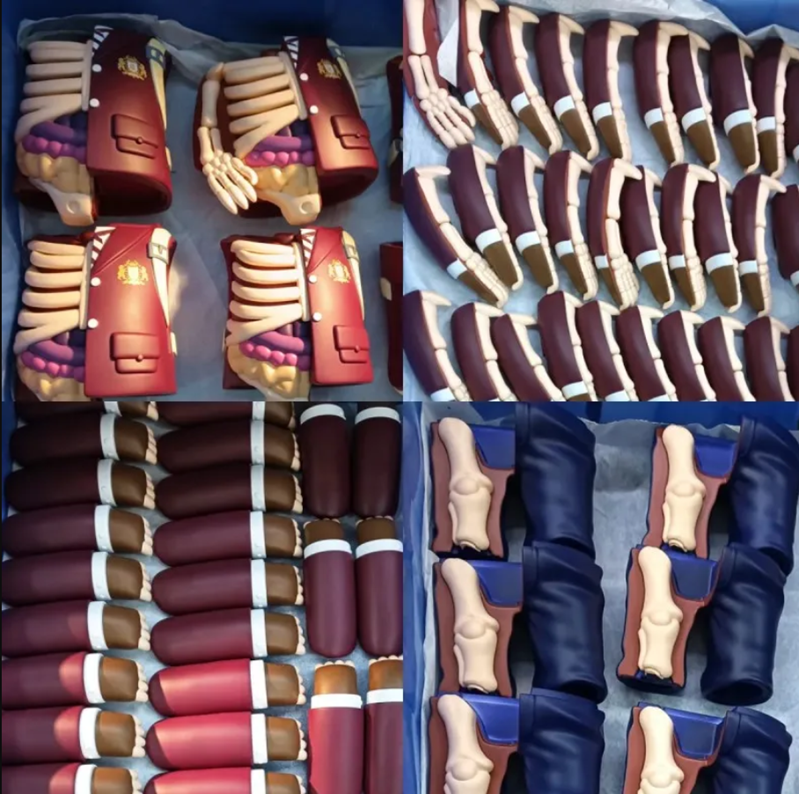
Before recommending a production approach, Pegasus works with buyers to understand how the finished product will be sold, displayed, transported, and reordered. Whether the project involves retail collectibles, hospitality décor, licensed merchandise, or corporate gifting, these commercial requirements influence material selection, tooling strategy, packaging design, production scheduling, and long-term manufacturing planning.
The Approved Prototype Must Become the Production Standard
The prototype is the most important reference in a bulk resin order.
It should not be treated merely as a presentation model used to secure approval. It must become a clearly documented manufacturing standard against which future units can be compared.
Depending on the project, the prototype stage may begin with:
- Two-dimensional artwork
- Character sheets
- CAD or sculpting files
- A clay model
- A physical original
- A three-dimensional scan
- A rough handmade sample
- Reference photographs
- A combination of digital and physical information
The manufacturer must convert these inputs into a design that can be reproduced consistently.
A Good Prototype Review Goes Beyond Appearance
The buyer should review more than colour and general shape. The approval process may need to confirm:
- Overall dimensions
- Proportions and posture
- Base size and stability
- Surface textures
- Facial or decorative details
- Assembly joints
- Removable components
- Material feel and weight
- Colour references
- Gloss or matte level
- Metallic, translucent, or stone-like effects
- Brand marks and edition numbers
- Packaging fit
The manufacturer should also identify features that may be difficult to reproduce reliably.
A very narrow projection, deep undercut, concealed recess, or unsupported component may appear successful in a handmade master while creating demoulding, air-release, breakage, or assembly problems during volume production.
This is where a manufacturing partner adds more value than a basic casting supplier. The design team should recommend practical adjustments while the prototype remains editable, explaining why each change is required and how it will affect the finished appearance.
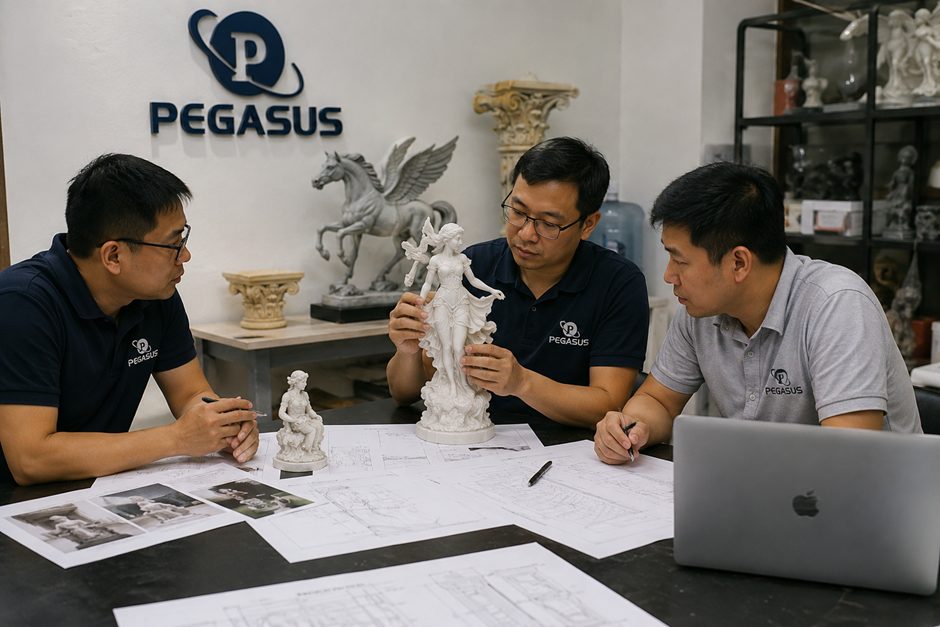
During prototype development, Pegasus evaluates every design from both an artistic and manufacturing perspective. The engineering team reviews balance, centre of gravity, mouldability, assembly methods, structural strength, and finishing requirements before tooling begins. Resolving these technical considerations early helps reduce production risks, improve manufacturing efficiency, and maintain the approved appearance throughout bulk production.
Create a Signed Golden Sample
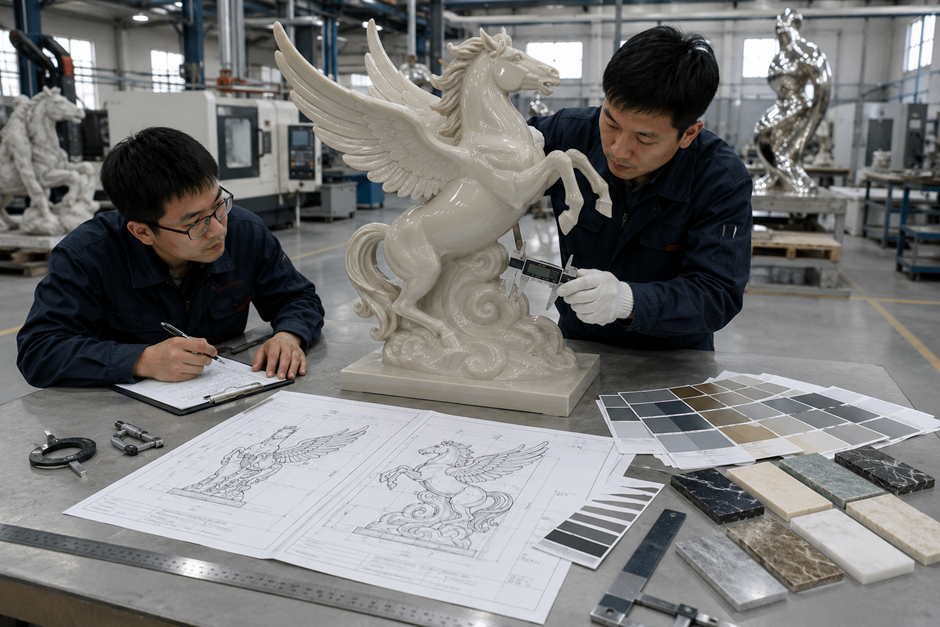
Once all design, material, finish, and assembly details are accepted, the buyer and manufacturer should approve a final reference unit—often called a golden sample.
This sample should represent the agreed standard for mass production.
Approval records should identify:
- Sample version
- Date of approval
- Dimensions and accepted tolerances
- Resin formulation or material specification
- Paint references
- Surface-finish standard
- Assembly requirements
- Packaging arrangement
- Approved minor variations, where applicable
- Name of the authorised approver
While photographs are useful for documentation, the approved physical sample should remain the primary production reference wherever possible. It allows the casting, finishing, and quality-control teams to compare every production batch against the same approved standard, reducing interpretation differences between departments.
Examine How the Manufacturer Designs Moulds for the Full Production Run
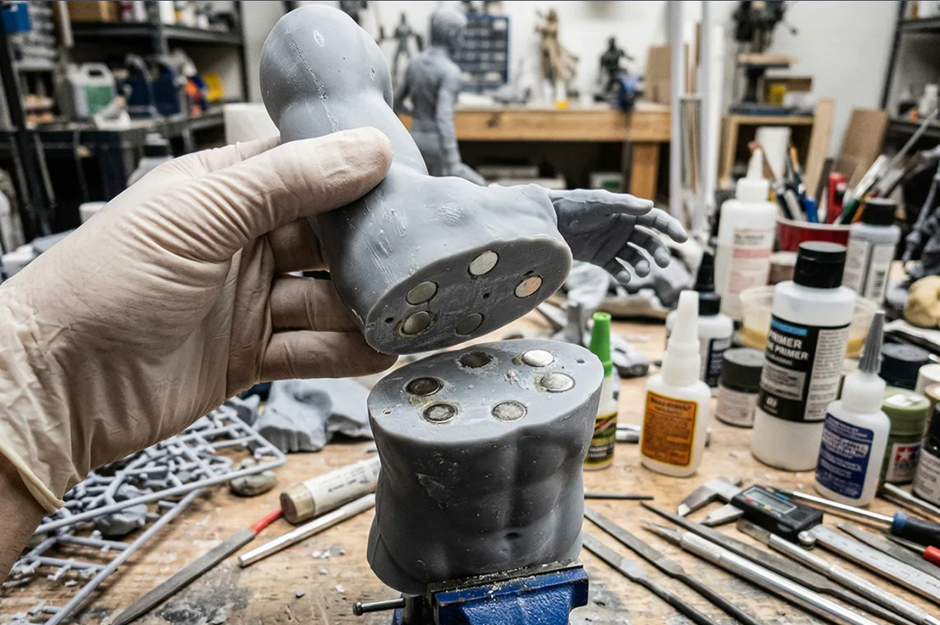
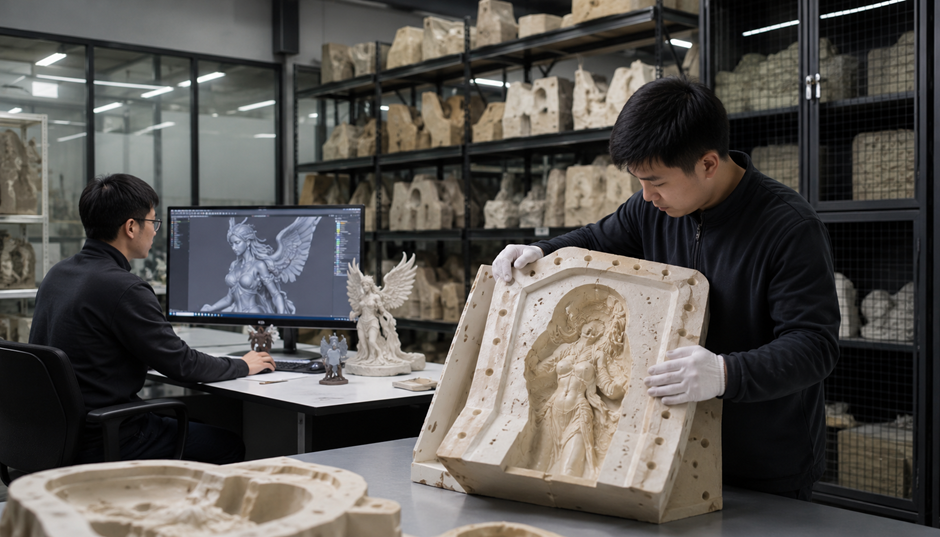
Mould planning is one of the clearest indicators of whether a supplier understands bulk production.
A mould that produces several good castings may not be suitable for the complete order. The manufacturer must estimate how tooling will perform throughout the planned quantity and whether replacement moulds will be required.
Key mould-planning considerations include:
- Silicone or tooling material
- Mould thickness
- Parting lines
- Vent positions
- Pouring gates
- Support shells
- Number of cavities
- Demoulding stress
- Expected mould life
- Replacement schedule
- Traceability between moulds and batches
Complex resin ornaments often need to be separated into several parts. The division strategy should protect visible surfaces, reduce trapped air, simplify demoulding, and create joints that can be assembled accurately.
Poor separation can result in:
- Visible seams
- Damaged fine details
- Misaligned components
- Weak connections
- Excessive filling and sanding
- Higher rejection rates
- Inconsistent dimensions
At Pegasus, mould engineering is planned according to the sculpture’s geometry, production quantity, and long-term manufacturing requirements. Venting, draft angles, wall thickness, support structures, and mould separation are carefully engineered to improve demoulding, reduce defects, and maintain dimensional consistency throughout the production programme. This approach helps ensure that quality remains stable even as production volumes increase.
Ask How Mould Wear Is Managed
Buyers should ask:
- How many acceptable castings are expected from each mould?
- How will mould wear be monitored?
- Will replacement moulds be required?
- Who owns the moulds after production?
- How will tooling be stored for repeat orders?
These questions affect quality, future reorder costs, lead times, and intellectual-property control.
The lowest tooling quotation is not automatically the lowest total cost. A weak mould may require extensive repair work or produce a high number of rejected pieces, while an appropriately engineered mould protects quality across a larger production run.
Confirm That Casting Controls Are Suitable for the Design
Casting quality begins before liquid resin reaches the mould.
The correct process depends on the selected resin, part geometry, wall thickness, finish, production quantity, and performance expectations.
A capable production partner should control:
- Resin-to-hardener ratio
- Mixing time
- Pigment or filler ratio
- Material temperature
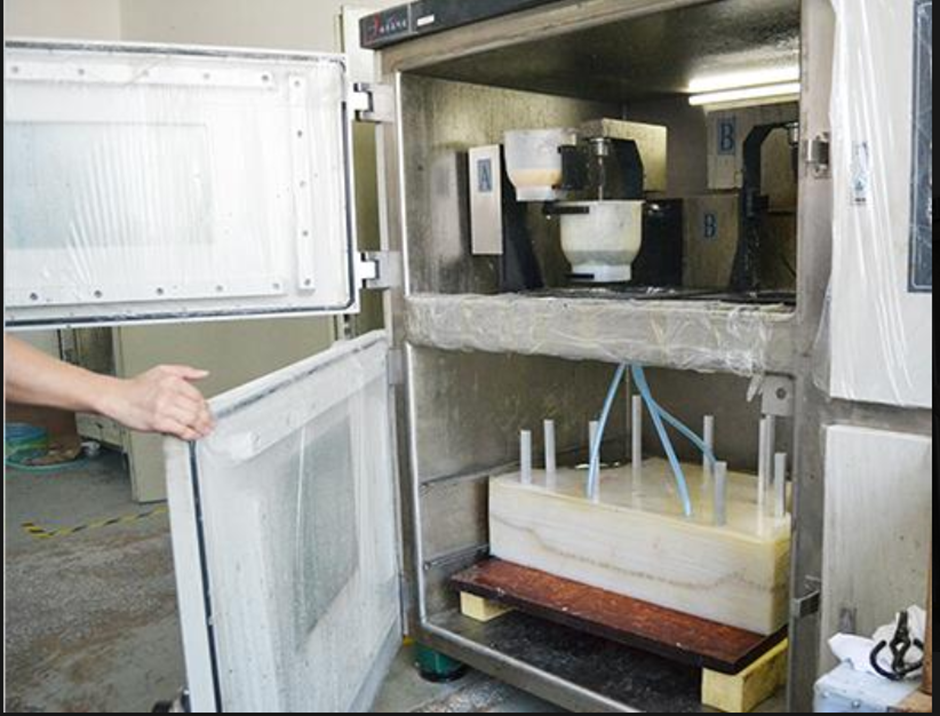
- Degassing
- Pouring method
- Mould temperature
- Curing time
- Post-curing
- Demoulding sequence
- Batch identification
For detailed resin statues and ornaments, uncontrolled air is a major risk. Bubbles may appear on the surface, weaken thin elements, or remain hidden inside structurally important areas.
Pegasus identifies vacuum degassing and controlled casting as core parts of its resin process, particularly where fine textures, complex details, and clear or translucent effects must be preserved. The company also describes post-curing and internal reinforcement as relevant for larger or more structurally demanding pieces.
Material Choice Should Match the Commercial Requirement
Not every custom piece should use the same resin system.
Depending on the brief, manufacturers may recommend polyurethane resin, polyester resin, polystone, or a specially modified formulation.
The selection may be influenced by:
- Required detail
- Impact resistance
- Dimensional stability
- Weight and premium feel
- Transparency
- Finish compatibility
- Size
- Production quantity
- Display conditions
- Cost target
Polystone, for example, may provide the heavier stone-like feel preferred for premium decorative objects, while polyurethane systems may be selected for detailed parts and stable reproduction.
An experienced manufacturing partner should recommend the most suitable material based on the project’s technical and commercial requirements rather than applying the same resin system to every design. For projects where natural stone is a better fit than resin, buyers can also explore Pegasus’s marble sculpture manufacturing capabilities to evaluate the most appropriate solution for their application.
Determine How Consistency Will Be Controlled Between Batches
Most buyers inspect the first few finished units carefully. The greater commercial risk may appear later, once several operators, moulds, casting batches, and painting stations are involved.
A professional mass-production plan should establish controls at defined checkpoints rather than relying on one final inspection.
First-Article Approval
The first completed pieces from production tooling should be inspected against the golden sample before the complete order moves forward.
This confirms whether the production mould, casting process, assembly procedure, and finishing sequence reproduce the approved standard.
In-Process Inspection
Checks during casting, trimming, assembly, filling, sanding, priming, and painting make it possible to correct problems before they are repeated across the full batch.
Batch Identification
Production records should make it possible to trace units to a casting or finishing batch. Traceability helps the factory investigate recurring defects and isolate affected units without rejecting an entire order unnecessarily.
Final Inspection
Completed units should be reviewed for:
- Dimensions
- Surface defects
- Colour consistency
- Finish level
- Missing details
- Joint alignment
- Base stability
- Component fit
- Adhesive marks
- Cleanliness
- Labelling
- Packaging completeness
The buyer should agree in advance on which variations are unacceptable, which minor variations are inherent to hand finishing, and how inspection samples will be selected.
Resin production often combines controlled industrial processes with hand-applied finishing. Absolute mechanical uniformity may not be realistic for every artistic effect, but acceptable variation must still be defined and managed.
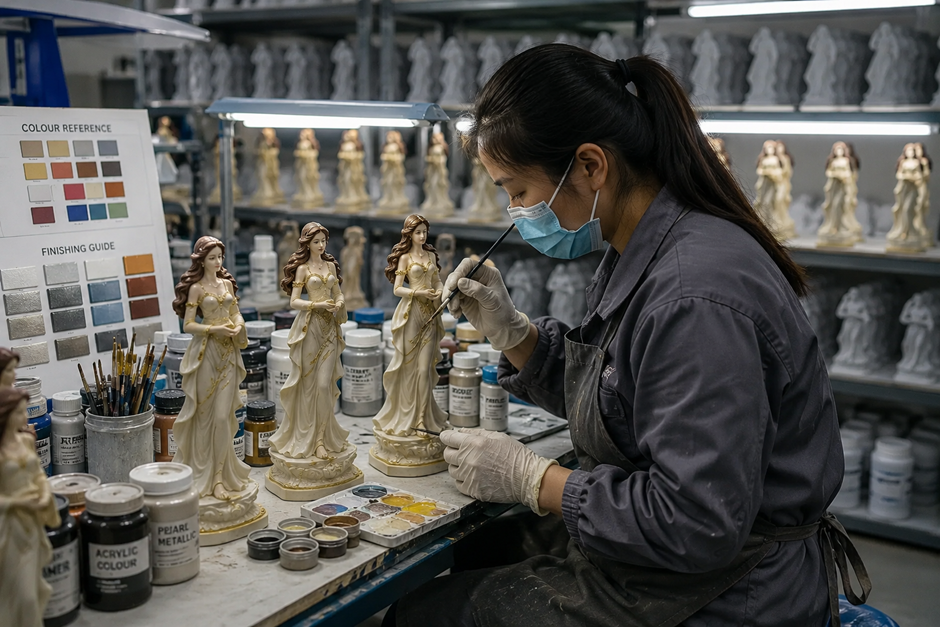
Evaluate Finishing as a Production System, Not a Craft Demonstration
Finishing is often the most visible difference between average and premium resin ornaments.
It can also become one of the greatest sources of inconsistency in a bulk order.
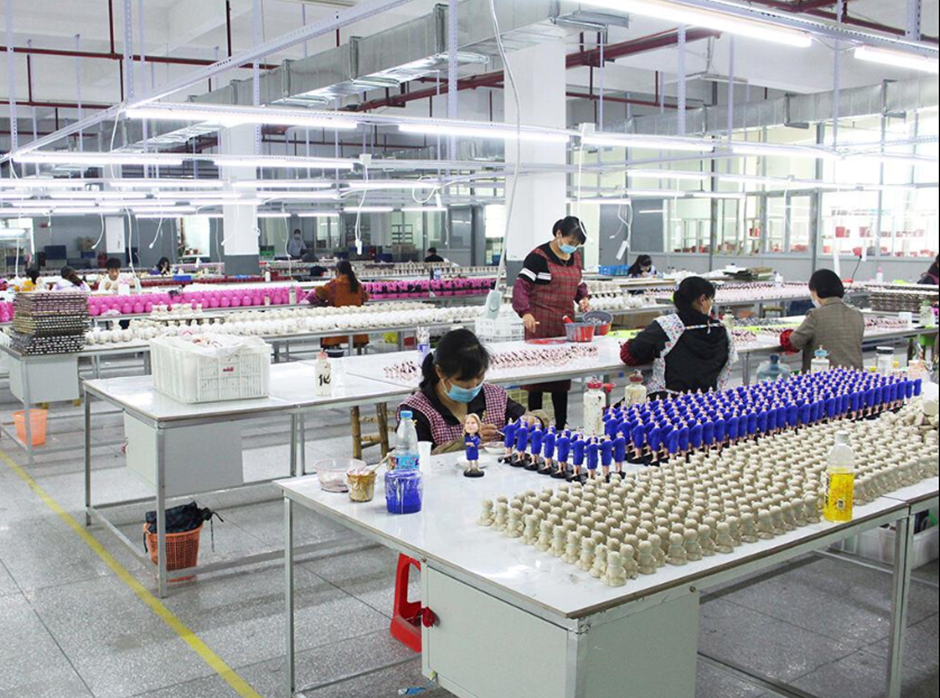
An experienced artist may produce one excellent sample. Bulk production requires a process that allows several finishing specialists to reproduce the same appearance without flattening the artistic character.
The manufacturer should establish:
- Surface-preparation procedure
- Primer system
- Paint sequence
- Colour references
- Layering method
- Drying time
- Masking requirements
- Metallic or pearlescent effects
- Weathering or patina standards
- Final clear coat
- Gloss-level tolerance
- Touch-up procedure
For detailed figurative work, finishing may include multiple skin-tone layers, shading, highlights, eye detailing, fabric textures, simulated metal, stone effects, or translucent elements.
Pegasus describes using specialised finishing areas and multi-stage techniques for matte, gloss, metallic, pearlescent, weathered, stone-like, and highly detailed figurative finishes.
Ask for a Colour-Control Process
Buyers should ask how colour will be controlled when:
- Production lasts several weeks
- More than one painter is assigned
- Additional batches are ordered later
- The design uses gradients or weathering
- The product must match brand colours
- Components are produced separately
The answer should include reference samples, documented formulas, working standards, and comparison under controlled lighting—not only the statement that an experienced painter will handle it.
Look Beyond the Finished Product to the Project-Management System
Supplier selection is often presented as a comparison of equipment, certifications, product photographs, and price.
Those factors matter, but bulk projects are also coordination exercises.
A manufacturer may have strong production capability and still create risk through:
- Slow responses
- Unclear responsibility
- Undocumented approvals
- Conflicting instructions
- Missed milestones
- Late notification of problems
- Incomplete export documentation
- Changes made without approval
Buyers should identify who will manage the project after the order is placed.
A dedicated contact should coordinate communication between:
- Buyer or brand
- Design team
- Three-dimensional modelling team
- Tooling department
- Casting workshop
- Finishing department
- Quality-control team
- Packaging supplier
- Logistics provider
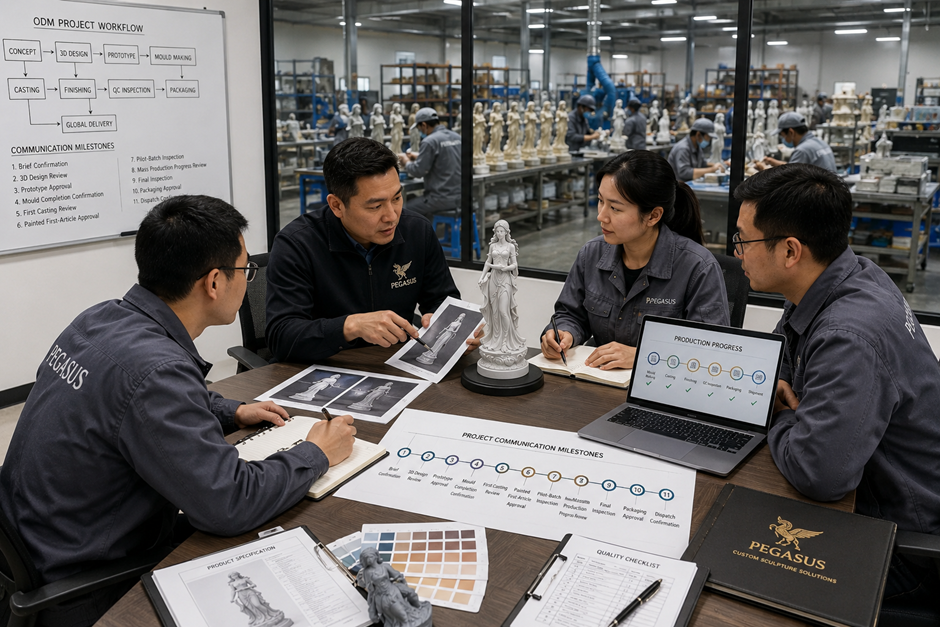
Pegasus presents its service as a connected ODM workflow from concept and prototyping through production, finishing, inspection, packaging, and international delivery. Its wider company manufacturing experience covers custom sculpture production and B2B project coordination across materials.
Agree on Communication Milestones
A practical project schedule may include:
- Brief confirmation
- Three-dimensional design review
- Prototype approval
- Mould-completion confirmation
- First casting review
- Painted first-article approval
- Pilot-batch inspection
- Mass-production progress review
- Final inspection
- Packaging approval
- Dispatch confirmation
The client does not need random workshop photographs every day. Updates should correspond with defined decisions and explain what is being reviewed.
This makes communication useful rather than overwhelming.
Protect the Design, Tooling, and Authorised Production Quantity
For original resin statues, licensed characters, artist editions, and branded ornaments, intellectual-property protection must be part of supplier selection.
The commercial assets may include:
- Original sketches
- Character designs
- Three-dimensional files
- Scans
- Master prototypes
- Production moulds
- Paint references
- Packaging artwork
- Brand marks
- Rejected units
- Excess production pieces
A buyer should confirm:
- Who can access the project files
- Whether a confidentiality agreement will be signed
- Where digital assets are stored
- Whether subcontractors are involved
- How rejected units are controlled
- Whether overproduction is prohibited
- Who owns the master and moulds
- Whether tools may be used for another customer
- How discontinued tools will be stored or destroyed
- How limited editions will be recorded
Pegasus states that it uses NDA-based controls for original files, mould tooling, and unauthorised production, positioning IP protection as part of its resin manufacturing service rather than an optional administrative detail. For a commercial buyer, this is not separate from quality. An accurately manufactured product that later appears through unauthorised channels can still damage the project financially.
Packaging Must Be Developed Before Production Is Complete
Packaging is frequently discussed too late.
When hundreds of finished pieces are ready but the packaging has not been validated, the buyer may face:
- Broken projections
- Surface abrasion
- Paint transfer
- Movement inside cartons
- Deformed parts
- Excessive carton dimensions
- Poor pallet stability
- High freight costs
- Retail packaging damage
- Delays while inserts are redesigned
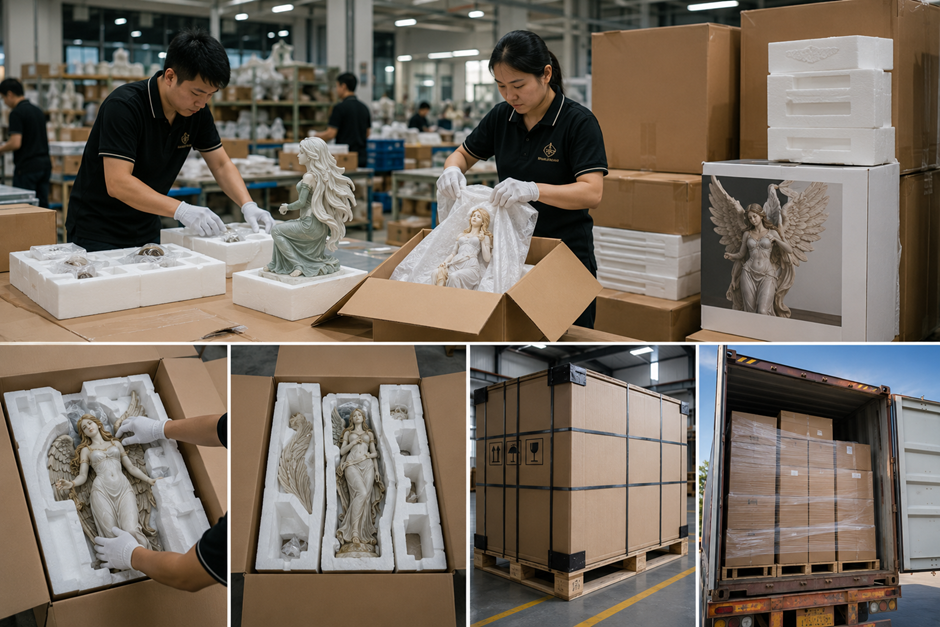
The package should be developed around the sculpture’s actual geometry, centre of gravity, vulnerable details, finish, assembly format, and distribution route.
Depending on the product, this may include:
- Soft protective wrapping
- Formed foam inserts
- EVA inserts
- Individual inner boxes
- Reinforced master cartons
- Corner protection
- Component compartments
- Moisture protection
- Palletisation
- Wooden crates
- Handling labels
Pegasus states that it develops geometry-specific protective packaging and validates new arrangements through transport-focused testing rather than relying solely on generic cushioning.
Packaging Is Also a Commercial Cost Decision
A package may protect the product but still be unsuitable if it creates unnecessary freight volume.
Good packaging should balance protection, presentation, and freight efficiency. Even small improvements in carton dimensions or pallet configuration can reduce shipping costs across large production orders without compromising product safety.
Confirm Whether the Supplier Can Support Repeat Orders
The first production run should not be planned in isolation when the buyer expects future demand.
Repeatability may depend on whether the factory retains:
- Approved three-dimensional files
- Golden sample
- Material specifications
- Paint formulas
- Mould records
- QC standards
- Packaging drawings
- Assembly instructions
- Supplier information
- Production photographs
The buyer should ask:
- How long will tooling be stored?
- Under what conditions will it be stored?
- Will the mould remain usable?
- What replacement-tooling costs may apply?
- Can the manufacturer reproduce the same finish later?
- How will raw-material substitutions be approved?
- What lead time should be expected for repeat production?
- Can the order quantity be increased or reduced?
A manufacturing partner should help the buyer establish a repeatable product platform, not force the entire development process to begin again with every reorder.
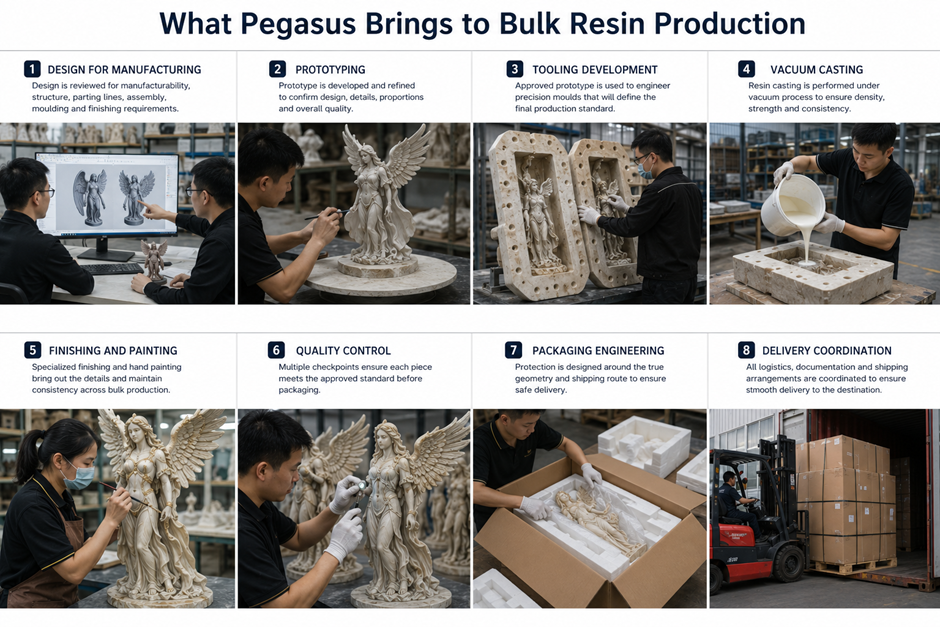
What Pegasus Brings to Bulk Resin Production
A buyer should select Pegasus for specific, verifiable reasons rather than simply because the company produces resin sculptures.
Pegasus’s value is the connection between the different stages of the programme.
Manufacturability Is Considered During Design
The project is reviewed as a production object, not only as a visual design. Form, balance, separation, assembly, moulding, and finish requirements can therefore be addressed before they become mass-production problems.
Prototyping Is Connected to Production Tooling
The approved prototype establishes the standard for mould engineering, casting, finishing, inspection, and packaging. This protects continuity as the project moves between departments.
Casting and Finishing Are Managed for Repetition
Vacuum casting, controlled curing, production-stage inspection, specialised finishing, and documented references help maintain consistency across more than one sample.
Packaging Is Treated as Part of Manufacturing
Protection is designed around the actual form and shipping route rather than added as a generic solution after production.
Buyers Can Source the Complete Programme Through One Partner
Pegasus supports design development, prototyping, tooling, casting, finishing, QC, packaging, and delivery coordination within one project workflow. This reduces the risk created when responsibilities are divided between unrelated suppliers.
Buyers can also review Pegasus’s completed custom sculpture projects to understand the company’s broader execution capabilities across different commercial applications.
A Practical Bulk-Production Workflow
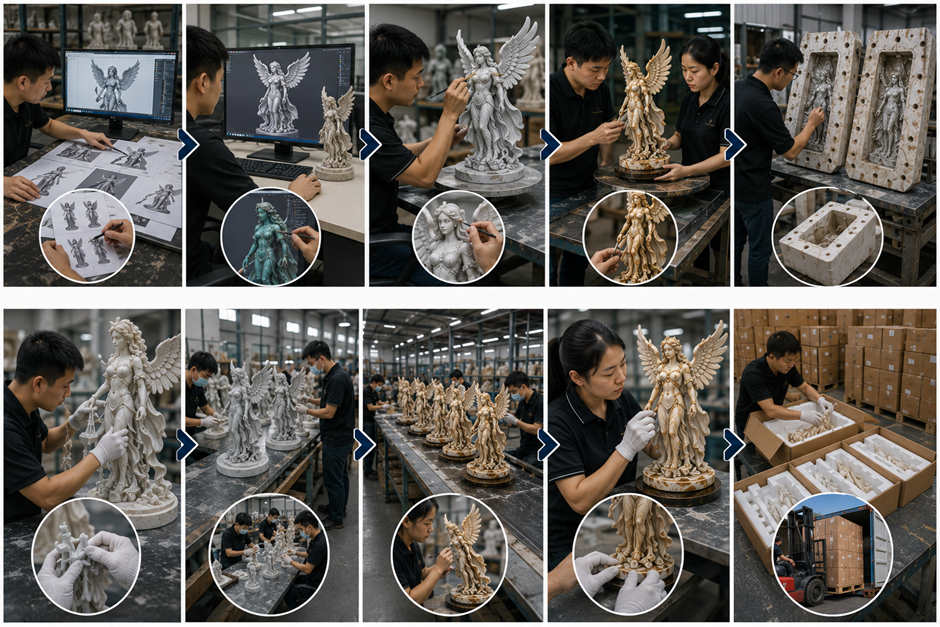
Although every order is different, a well-managed custom resin programme commonly follows this sequence.
1. Project Brief and Feasibility Review
The buyer provides artwork, dimensions, quantity, finish requirements, target market, packaging expectations, and delivery date.
Pegasus reviews whether the concept is suitable for resin and identifies the information required for pricing and development.
2. Design Development
The concept is converted into a production-ready digital model or refined physical master. Proportions, balance, separation, joints, and delicate features are reviewed.
3. Prototype Production
A master prototype is produced and refined. The buyer reviews the sculpture’s appearance and key commercial requirements.
4. Golden Sample Approval
Material, colour, texture, assembly, stability, branding, and presentation are approved. The final sample becomes the production reference.
5. Mould Engineering
Moulds are designed according to part geometry and order quantity. Venting, gates, separation lines, support shells, and expected mould life are established.
6. First-Article Production
The first complete units from production tooling are cast, assembled, finished, and inspected against the golden sample.
7. Pilot Batch
A controlled initial batch confirms that the process remains stable across multiple units and operators.
8. Mass Production
Casting and finishing proceed according to the approved schedule, with inspections at defined stages.
9. Final Quality Control
Units are checked for appearance, dimensions, stability, assembly, completeness, and packaging readiness.
10. Packing and Delivery
Approved products are packed according to the validated arrangement and prepared for domestic or international distribution.
The importance of this workflow is not the number of stages. Its value comes from using each approval to protect the next stage.
A rushed prototype creates tooling problems. Weak tooling creates casting variation. Inconsistent casting increases finishing work. Poor finishing control creates rejected units. Late packaging development creates transport damage.
A capable manufacturing partner manages these dependencies as one programme.
Questions to Ask Before Choosing a Resin Manufacturing Partner
Before placing a bulk order, procurement teams should ask:
- Have you produced comparable resin ornaments or statues at our required quantity?
- Who will review the design for mass-production feasibility?
- How will the golden sample be documented and stored?
- Which resin system do you recommend, and why?
- How will the design be divided into mouldable parts?
- What is the expected mould life?
- How will replacement moulds be managed?
- Do you use vacuum degassing or another air-control process?
- How are resin ratios and curing conditions controlled?
- How will colour consistency be maintained between painters and batches?
- At which stages will we receive samples or approvals?
- How will our files, moulds, and excess units be protected?
- Is packaging tested before the full order is dispatched?
- How will cartons and pallets be optimised for shipping?
- Who will manage communication between departments?
The quality of the answers is often more informative than the quotation itself.
A credible manufacturer should be able to explain the process clearly, identify genuine risks, and describe how those risks will be controlled.
Warning Signs During Supplier Selection
Buyers should be cautious when a supplier:
- Provides a mass-production quotation without properly reviewing your design.
- Promises perfect replication without discussing production tolerances or manufacturing limitations.
- Cannot clearly explain its mould strategy or expected mould life.
- Relies only on finished product photographs instead of documented production processes.
- Has no defined prototype approval or golden sample procedure.
- Cannot explain how quality will be monitored throughout production, not just at final inspection.
- Uses generic packaging without considering the product’s geometry or shipping requirements.
- Cannot explain how original designs, moulds, and intellectual property will be protected.
- Promises unusually short lead times without explaining production capacity or workflow.
Supplier selection should not become a search for a factory that says yes to every request.
The stronger partner is often the one that identifies constraints early, proposes workable alternatives, and explains what must be approved before production proceeds.
Frequently Asked Questions
What information should I provide when requesting a quote for bulk resin ornaments?
Provide the design or reference images, required dimensions, estimated quantity, preferred finish, intended use, packaging expectations, destination country, and target delivery date. Three-dimensional files or an existing master sample are helpful but not always essential at the first enquiry stage.
Should I approve a prototype before bulk production begins?
Yes. A complete prototype or golden sample should normally be approved before production tooling and mass manufacture proceed. It establishes the reference for dimensions, colour, finish, assembly, stability, branding, and packaging.
How can a manufacturer maintain consistency across hand-painted resin statues?
The manufacturer should use approved physical samples, documented paint formulas, defined layer sequences, controlled lighting, trained finishing teams, in-process inspections, and agreed tolerances for artistic variation.
What causes bubbles in resin castings?
Bubbles may result from air introduced during mixing, trapped air inside the mould, unsuitable venting, uncontrolled pouring, or inadequate degassing. The casting method and mould design should be selected according to the geometry and detail requirements.
Who should own the master prototype and production moulds?
Ownership should be defined in the commercial agreement. The buyer should also confirm storage periods, permitted use, repeat-order arrangements, confidentiality, and what happens to the tools when the project ends.
How should resin ornaments be packed for international shipping?
Packaging should be designed around the object’s shape, finish, weight, vulnerable details, and transport route. Depending on the product, it may include fitted foam or EVA inserts, individual cartons, reinforced master cartons, pallets, or wooden crates.
Can Pegasus support both product development and mass production?
Yes. Pegasus supports a connected resin-production workflow that can include concept development, three-dimensional modelling, master prototyping, mould engineering, casting, finishing, quality control, custom packaging, and delivery coordination.
How can I discuss a new bulk resin project with Pegasus?
Prepare your available artwork, dimensions, quantity, finish expectations, application, destination, and target schedule. You can then contact the Pegasus team for a project review and quotation.
Conclusion
Choosing a manufacturing partner for custom resin ornaments and statues is ultimately about protecting consistency. From the first approved prototype to the final packaged shipment, every stage influences the next. When design development, mould engineering, casting, finishing, quality control, packaging, and logistics are managed as one connected workflow, buyers gain more than a supplier—they gain confidence that the approved standard will be maintained throughout the project.
Pegasus approaches resin manufacturing with exactly that philosophy. By combining engineering expertise, controlled production processes, specialised finishing, and international project support, the team helps commercial buyers transform original concepts into repeatable, high-quality resin collections ready for global delivery.
The most important question is therefore not “Who can manufacture this resin statue?”
It is:
“Which manufacturing partner can consistently deliver the approved standard from prototype to production?”