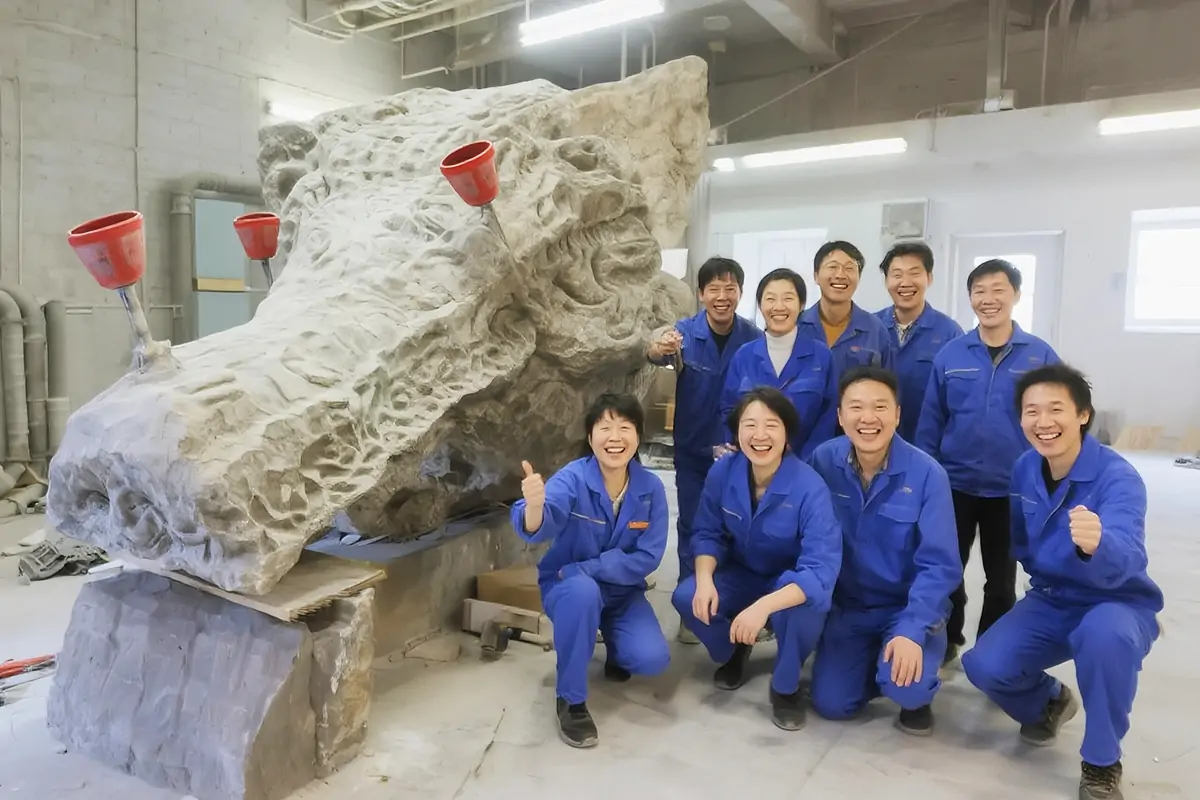
Commissioning a contemporary marble sculpture is very different from selecting a finished piece from a catalogue. The client is not simply purchasing an object; they are beginning a collaborative project involving artistic development, stone selection, technical planning, manufacturing, quality approval, transportation, and installation.
For architects, developers, hospitality groups, municipalities, art consultants, and private collectors, understanding this journey is important because decisions made during the earliest stages can influence the sculpture’s appearance, structural performance, production cost, delivery schedule, and long-term suitability for its environment.
An experienced marble sculptures manufacturer should therefore do more than reproduce an approved image. The manufacturer should help the client determine whether the concept can be manufactured successfully, which type of marble is appropriate, how the sculpture will be supported and transported, and what must be prepared at the installation site.
At Pegasus, each commission begins with understanding the complete project rather than focusing only on the carving stage. Based on experience managing commercial sculpture projects, early coordination between the client, design team, engineers, production specialists, logistics providers, and installation contractors usually leads to a more predictable and successful outcome.
This guide explains what clients should expect at each stage of a contemporary marble sculpture commission, from the first project discussion through final installation.
Commissioning Is a Project, Not a Single Purchase
A ready-made marble sculpture already has defined dimensions, material, finish, and structural characteristics. A commissioned sculpture begins with a concept that must be translated into a manufacturable and installable form.
The client may begin with an artist’s sketch, architectural rendering, reference image, physical maquette, three-dimensional model, or simply an initial creative direction. Before production can begin, that information must be developed into clear specifications.
Clients should expect discussions covering:
- The artistic purpose of the sculpture
- Its intended location and viewing angles
- Required dimensions and proportions
- Preferred marble colour and veining
- Indoor or outdoor exposure
- Foundation and anchoring requirements
- Site access and lifting conditions
- Delivery deadlines
- Approval responsibilities
- Available project budget
These questions are not administrative formalities. They directly influence the engineering, manufacturing, and installation strategy.
Based on Pegasus’s project experience, the most avoidable problems usually occur when production begins before the dimensions, stone characteristics, structural requirements, or site conditions have been properly confirmed. A well-managed commission therefore invests sufficient time in planning before any marble is carved.
Stage 1: Defining the Project Vision and Commercial Objectives
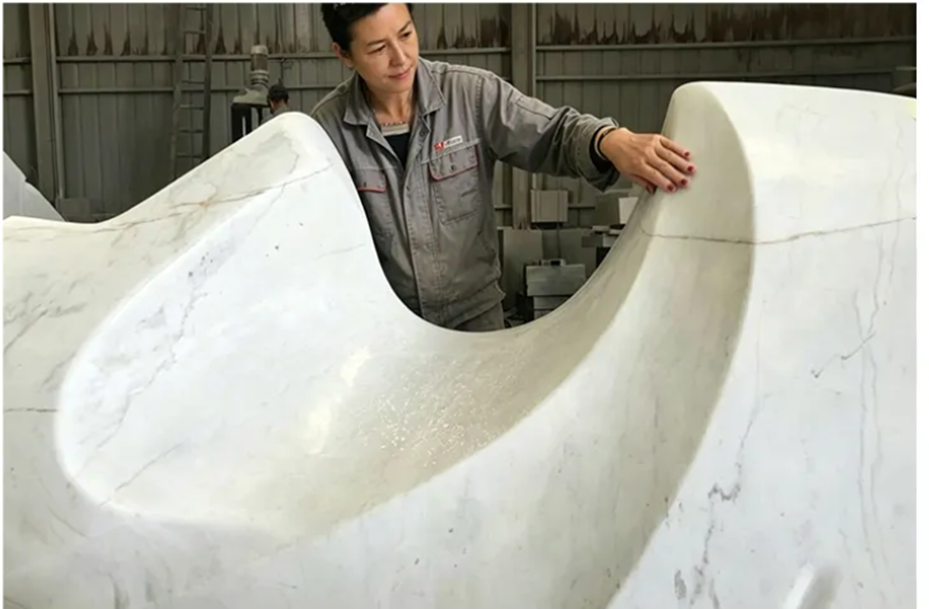
The first stage is to clarify what the sculpture must achieve within the wider project.
A contemporary marble sculpture for a hotel entrance may need to create an immediate sense of luxury while complementing the architecture. A public artwork may need to communicate a cultural theme and perform reliably in an exposed environment. A sculpture for a corporate headquarters may need to reflect the organisation’s identity without appearing overly decorative.
Clients should therefore expect the manufacturer to ask questions beyond the sculpture’s visual appearance.
These may include:
- Who will interact with or view the sculpture?
- Will it act as a landmark, focal point, or supporting design element?
- From which directions will it be seen?
- Will people be able to touch or approach it?
- Does the sculpture need to coordinate with surrounding stone, landscaping, lighting, or water features?
- Are there planning, safety, or public-access requirements?
- Is the installation permanent, relocatable, or part of a phased development?
The answers help define whether the proposed scale, material, finish, and location are suitable.
Pegasus uses this stage to understand both the artistic vision and the commercial purpose of the commission. This is important because two sculptures with a similar visual concept may require completely different manufacturing strategies depending on where and how they will be installed.
For example, an interior lobby sculpture may allow a highly polished surface and delicate projections because it is protected from severe weather and uncontrolled interaction. An outdoor sculpture in a busy public plaza may require stronger sections, more secure anchoring, a different finish, and easier maintenance access.
What the Client Should Provide
To make the first stage productive, the client should provide as much of the following information as possible:
- Concept sketches or reference images
- Proposed dimensions
- Architectural drawings or site photographs
- Target installation date
- Preferred material or colour
- Approximate budget range
- Details of the artist, architect, or project representative
- Any site-access restrictions
Not every detail must be final at the beginning. However, better information enables the manufacturer to identify risks and recommend practical solutions earlier.
Stage 2: Developing the Concept into an Approved Design
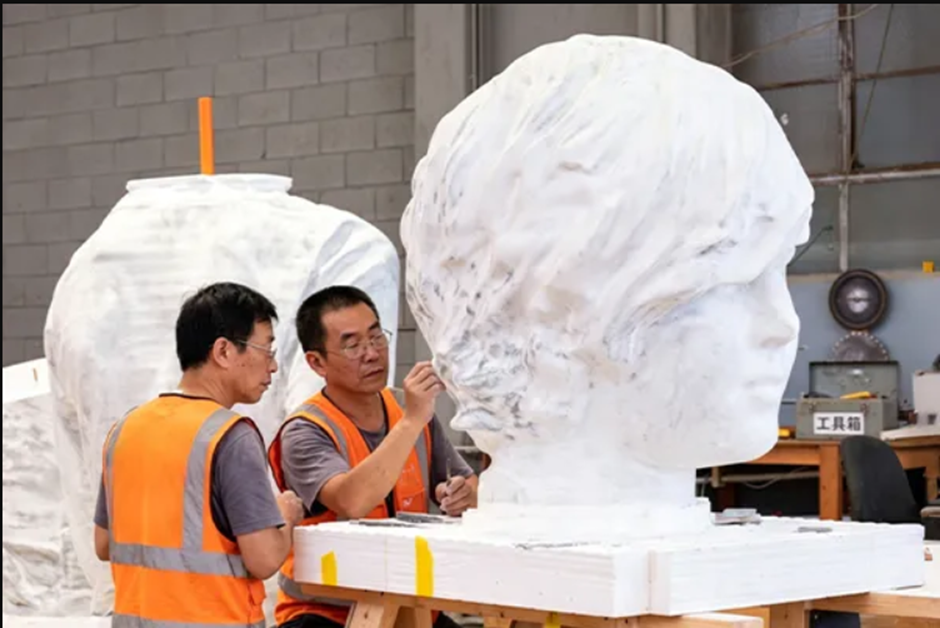
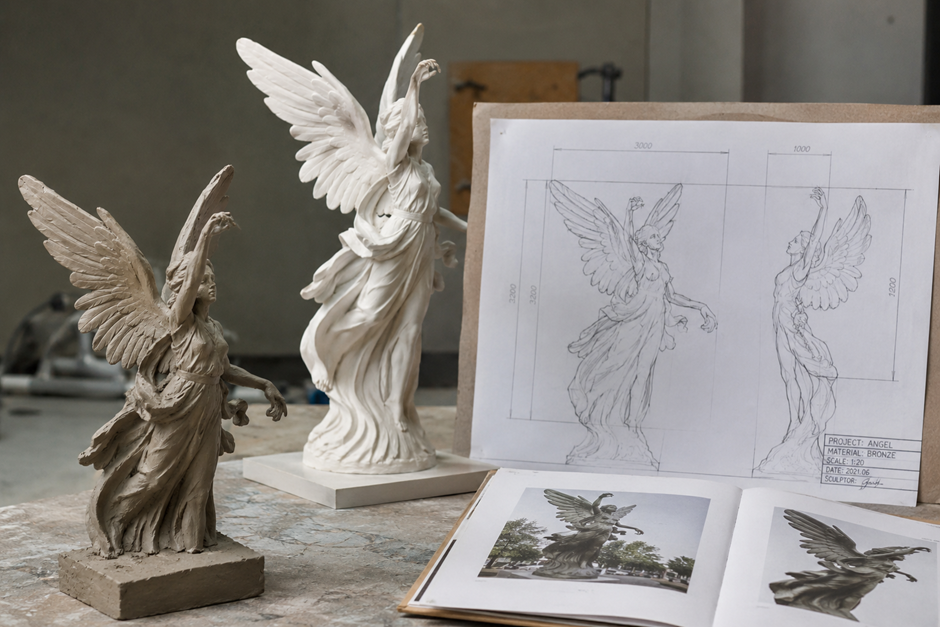
Once the project objectives are clear, the creative concept must be developed into a design that can be accurately evaluated and manufactured.
Clients should expect this stage to include one or more of the following:
- Refined sketches
- Digital three-dimensional modelling
- Scaled drawings
- Photomontages showing the sculpture at the proposed site
- Physical maquettes
- Material and finish samples
- Reviews of proportions and viewing angles
- Design revisions based on manufacturing feasibility
The purpose is not to reduce the artistic quality of the concept. It is to protect it by ensuring that the final sculpture can be produced, transported, installed, and maintained without compromising its intended appearance.
For a large contemporary marble sculpture, small changes in proportions can have a significant impact. A narrow connection, extended limb, deep undercut, or unsupported section may appear acceptable in a digital rendering but could be vulnerable when translated into natural stone.
This is where an experienced manufacturer adds practical value. Rather than waiting until carving has begun, Pegasus reviews potential manufacturing and structural challenges while the design is still being developed.
Clients should expect clear communication when part of the concept requires adjustment. A responsible recommendation should explain:
- What the risk is
- Why the risk matters
- How the proposed modification solves it
- Whether the change affects appearance, cost, or timing
- What alternative approaches are available
This helps the client make an informed decision rather than receiving unexplained changes after production has started.
Client Approval at the Design Stage
Before the marble block is processed, the client should approve the key design information.
Depending on the project, approval may include:
- Overall form
- Final dimensions
- Orientation
- Base or pedestal relationship
- Surface texture
- Marble type
- Visible veining preferences
- Structural connection points
- Division of large sections
- Installation position
Approval responsibilities should also be clearly defined. On some projects, the artist approves the form while the architect approves integration with the site and the client approves the commercial scope. Establishing this process early avoids conflicting instructions later.
Stage 3: Selecting Marble for Appearance and Performance
The choice of stone is one of the most important decisions in a marble commission.
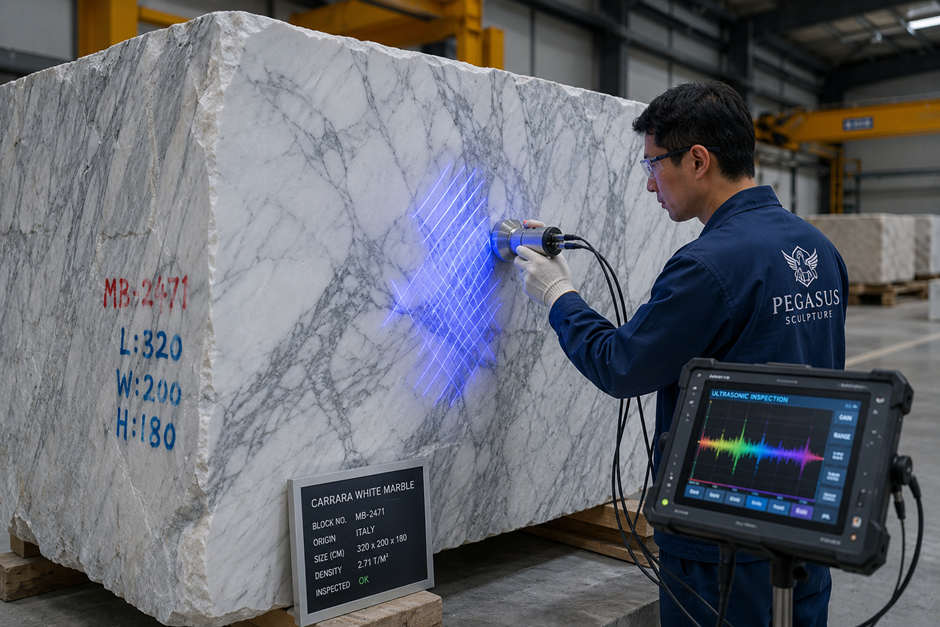
Clients often begin with a preferred colour, but colour alone should not determine the selection. Marble is a natural material, meaning every block has individual characteristics, including veining, mineral variation, density, translucency, and possible natural inclusions.
The appropriate marble depends on:
- The sculpture’s design
- Required block dimensions
- Level of fine detail
- Indoor or outdoor use
- Expected weather exposure
- Desired finish
- Availability
- Budget
- Long-term maintenance expectations
A marble suitable for a small interior figure may not be the best option for a large outdoor sculpture with extended or structurally demanding elements.
Based on Pegasus’s experience, stone selection should be treated as both an artistic and production decision. The goal is not merely to locate an attractive block; it is to select material capable of supporting the intended form and project conditions.
What Clients Should Expect During Stone Selection
The client may receive:
- Photographs or videos of available blocks
- Information about block dimensions
- Close-up views of veining and colour
- Recommendations based on the sculpture design
- Explanations of visible natural variation
- Guidance on whether multiple blocks will be required
For a contemporary marble sculpture, veining can become part of the artistic composition. The orientation of the sculpture within the block may therefore be planned to use the stone’s natural movement intentionally.
Where a sculpture is divided into several sections, the production team should also consider how the colour and vein direction will relate across the assembled work.
Clients should understand that natural marble cannot provide the absolute uniformity of a manufactured material. Clear approval of the selected block helps establish realistic expectations before carving begins.
Stage 4: Confirming Engineering, Support, and Installation Requirements
Engineering should not be postponed until the sculpture is complete.
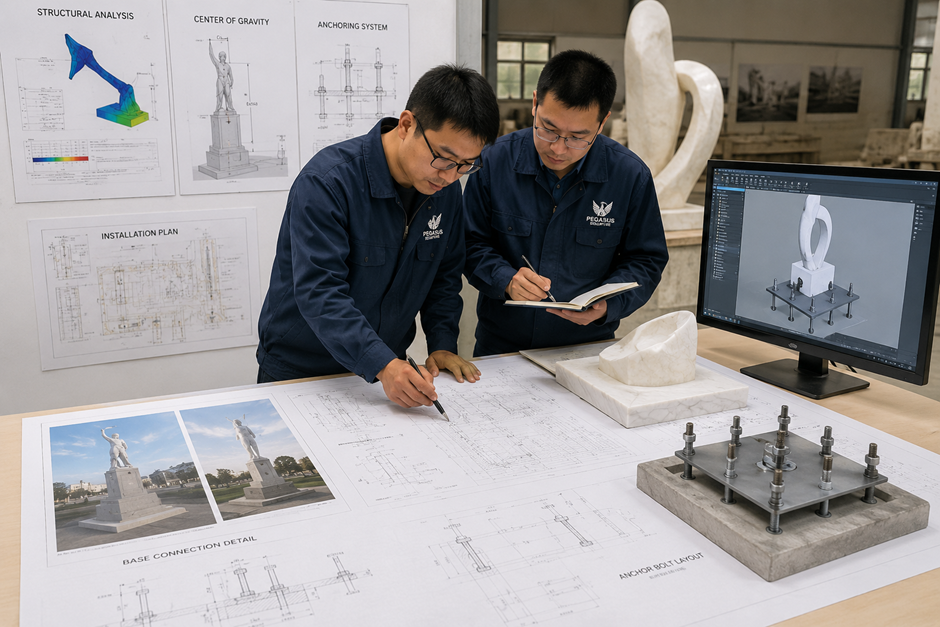
Marble is durable, but it is also heavy and behaves differently from fabricated metal or FRP. The sculpture’s weight, centre of gravity, section thicknesses, base connection, lifting points, and installation position must be considered before manufacturing begins.
Clients should expect the project team to review:
- Estimated finished weight
- Base dimensions
- Structural stability
- Internal or external support requirements
- Anchoring method
- Pedestal or foundation design
- Lifting strategy
- Temporary support during transportation
- Assembly sequence
- Site access for cranes or lifting equipment
These considerations are particularly important for large sculptures, elevated installations, exterior public art, and designs containing narrow or projecting elements.
Pegasus’s engineering and production teams use this review to determine how the artistic design can be manufactured and installed safely without introducing unnecessary visual changes.
For example, a sculpture that appears as a single continuous form may need to be produced in separate sections because of block size, container dimensions, site access, or lifting restrictions. When this is identified early, the joints and assembly sequence can be incorporated discreetly into the design.
Why Site Information Matters
The manufacturer cannot finalise an installation strategy without understanding the site.
Clients should provide:
- Foundation drawings
- Access routes
- Door or gateway dimensions
- Floor-loading information for interior installations
- Crane positioning options
- Working-height restrictions
- Nearby landscaping or structures
- Local safety requirements
- Installation contractor details
Based on real project experience, Pegasus recommends resolving these issues before production progresses too far. A sculpture may leave the factory in perfect condition but still create serious delays if the delivery vehicle cannot enter the site or the lifting equipment cannot reach the installation position.
Stage 5: Establishing the Quotation, Timeline, and Approval Schedule
Once the concept, dimensions, material, and technical scope have been defined, the manufacturer can prepare a more reliable commercial proposal.
Clients should expect the quotation to reflect more than the marble and carving labour.
The total project scope may include:
- Design development
- Three-dimensional modelling
- Maquette production
- Marble sourcing
- Structural engineering
- CNC rough shaping
- Hand carving and finishing
- Internal supports or fixing components
- Quality inspections
- Protective packing
- Inland transportation
- International freight
- Insurance
- Site installation support
The final cost is influenced by the sculpture’s dimensions, design complexity, marble selection, required level of detail, production schedule, sectioning strategy, finish, transport route, and installation requirements.
A responsible marble statue supplier should clearly explain which services are included and which responsibilities remain with the client or local contractor.
Understanding the Project Timeline
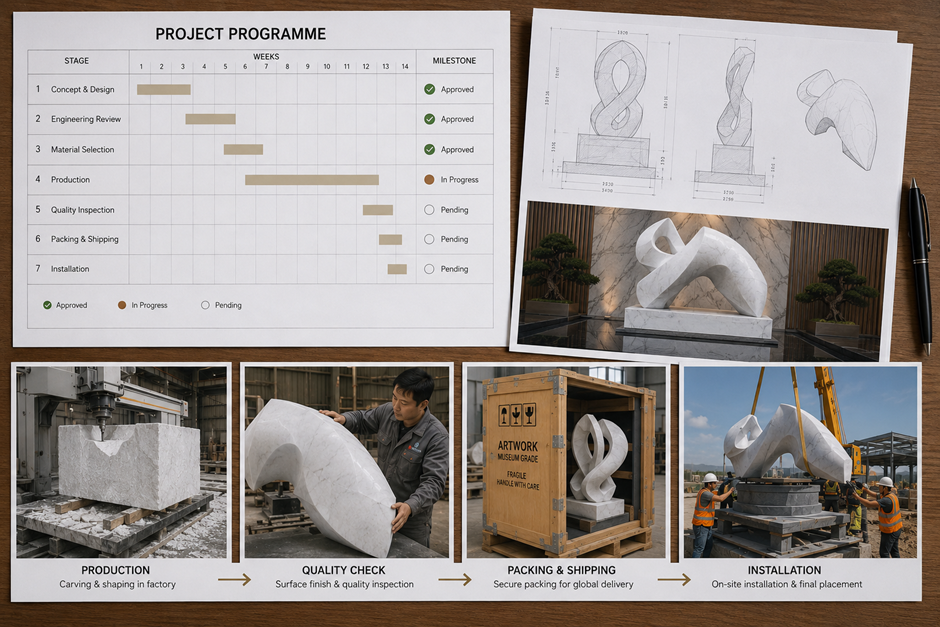
Clients should also expect a staged timeline rather than a single delivery date.
A typical programme may include:
- Concept confirmation
- Design and maquette approval
- Stone selection
- Engineering review
- Production
- Intermediate progress inspection
- Final finishing
- Client approval
- Packing and shipping
- Customs clearance
- Site installation
The duration varies according to scale and complexity. Clients should avoid relying on a generic production estimate before the complete project has been reviewed.
From Pegasus’s perspective, the best schedule is not simply the fastest one. It is the schedule that allows sufficient time for approvals, manufacturing, inspections, logistics, and site preparation without compromising quality or creating unnecessary risk.
Stage 6: Manufacturing the Approved Sculpture
Once the design, stone, engineering, and commercial scope have been approved, manufacturing can begin.
This stage may involve a combination of digital technology and traditional craftsmanship. However, the purpose of this article is not to repeat the full technical production process covered in Pegasus’s existing manufacturing content. From the client’s perspective, the more important question is what they should expect while their sculpture is being produced.
Clients should expect:
- Confirmation that the approved stone has entered production
- Progress updates at agreed milestones
- Photographs or videos from key production stages
- Opportunities to review the overall form before final detailing
- Notification of any unexpected natural stone characteristics
- Confirmation before irreversible finishing decisions are made
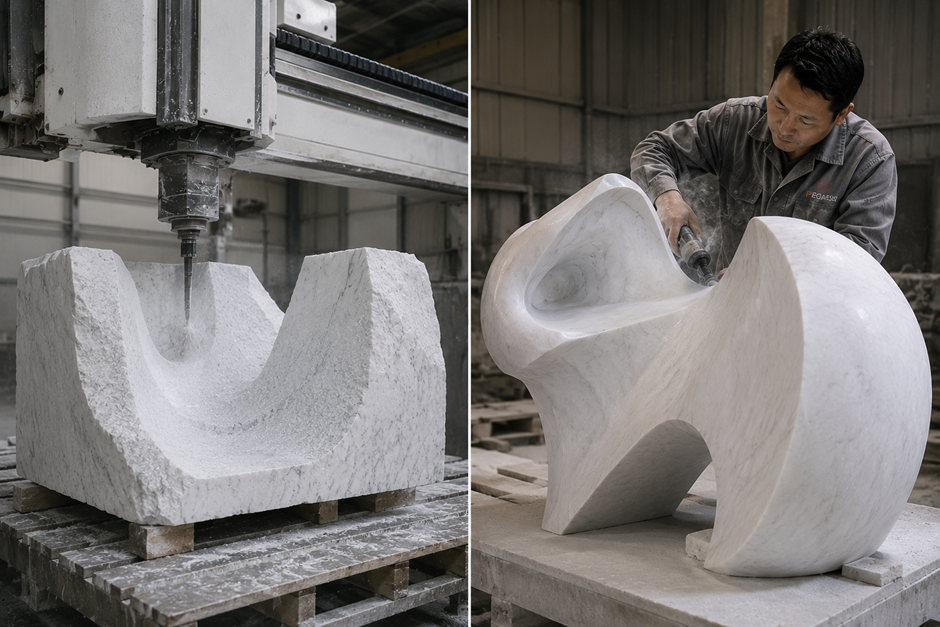
Large marble blocks may first undergo rough cutting to remove excess material. CNC equipment can then assist with establishing major forms, dimensions, and complex geometry. Skilled sculptors continue the process by refining transitions, details, textures, and the final artistic character.
Technology supports precision, but the final quality of a contemporary marble sculpture still depends heavily on experienced judgement. Surface continuity, edge refinement, visual balance, and the treatment of fine details require careful manual assessment.
What Happens When the Stone Reveals Natural Variation?
Because marble is natural, internal veins or mineral variations may become more visible as carving progresses.
An experienced production team should evaluate whether the variation:
- Is visually acceptable
- Can be incorporated into the design
- Requires an adjustment in orientation or detailing
- Has any structural significance
- Should be communicated to the client
Pegasus treats this communication as part of project management. Clients should not discover a meaningful change only when the final sculpture is ready for dispatch.
Stage 7: Monitoring Progress and Managing Client Approvals
A client should not have to wait until production is finished to understand whether the project is progressing correctly.
Approval stages should be agreed before manufacturing begins. Depending on the commission, they may include:
- Marble block approval
- Maquette or digital model approval
- Rough-form review
- Proportion and dimensional review
- Detail review
- Surface-finish sample approval
- Final factory inspection
- Packing approval
Progress updates are most useful when each one has a clear purpose. Sending a large number of workshop photographs without explaining what is being reviewed can create confusion rather than confidence.
For example, during rough shaping, the sculpture will not yet have its final surface quality. The client should be told whether they are approving dimensions and proportions rather than judging unfinished details.
Pegasus’s project team coordinates communication between design, engineering, production, and quality-control teams so that the client understands what has been completed, what remains in progress, and what requires approval.
How Clients Can Keep Approvals Efficient
Clients should nominate one authorised decision-maker or establish a clear approval hierarchy. When several stakeholders provide conflicting instructions, production can be delayed and previously approved work may require revision.
For projects involving architects, artists, developers, and consultants, an approval schedule should define:
- Who reviews each stage
- What they are authorised to approve
- How comments will be consolidated
- How quickly approval is expected
- What happens when a change affects cost or delivery
This structure protects both the creative vision and the programme.
Stage 8: Quality Inspection Before Packing
Final approval should involve more than viewing an attractive photograph of the completed sculpture.
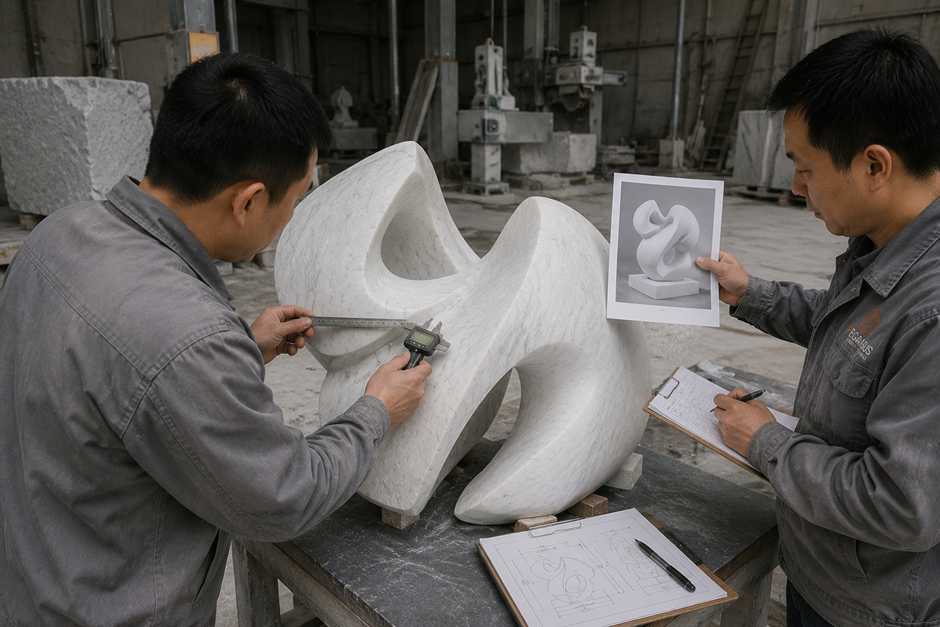
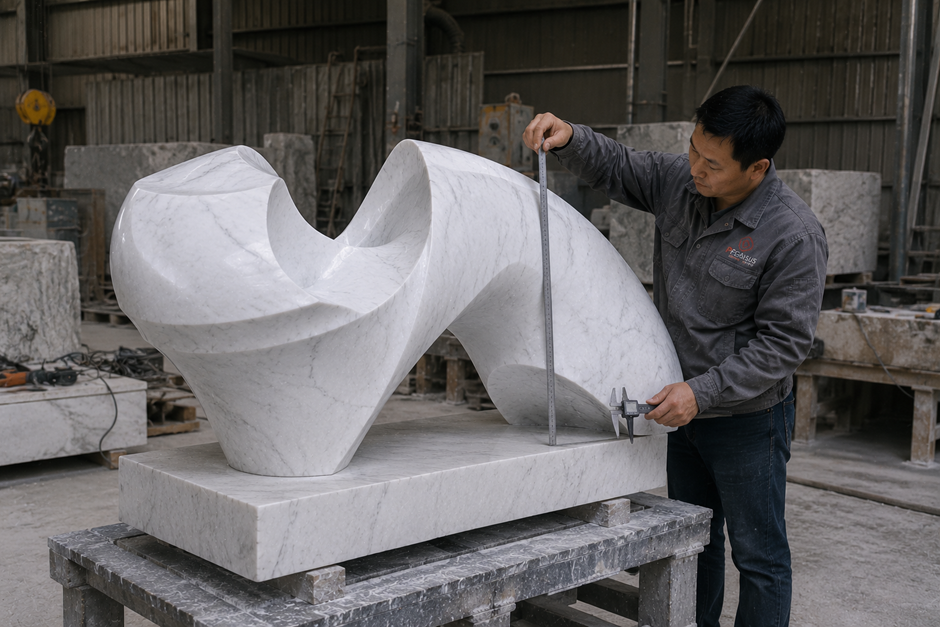
Before packing, a marble sculpture should be inspected for:
- Overall dimensions
- Proportions
- Surface consistency
- Carving details
- Finish quality
- Joint alignment
- Base dimensions
- Fixing points
- Visible cracks or damage
- Stability during handling
- Compliance with the approved design
Where possible, key components may also be trial assembled before dispatch.
At Pegasus, inspection is connected to the entire project scope. The team does not review only the sculpture’s visible surface; it also considers whether the work is ready for lifting, transport, assembly, and installation.
This is one of the areas where real project experience matters. A sculpture can appear complete artistically while still requiring adjustments to a base plate, lifting provision, joint alignment, or protective packing arrangement.
Clients should receive clear final documentation showing that the sculpture is ready to proceed to packing and shipping.
Stage 9: Packing and International Transportation
Marble sculptures require project-specific protection because their size, weight, shape, and vulnerable details vary significantly.
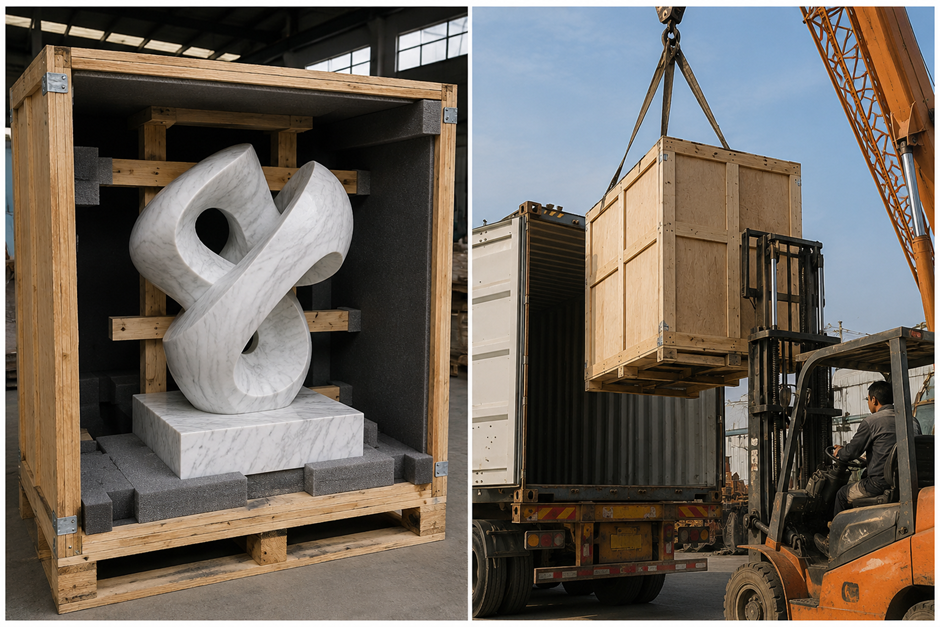
Clients should expect the packing plan to be developed around the actual sculpture rather than relying on a generic crate.
Depending on the design, protection may include:
- Custom timber crates
- Internal framing
- Soft protective layers
- Foam support
- Reinforcement around projecting details
- Separation between individual sections
- Moisture protection
- Clear lifting and handling instructions
- Identification labels for installation components
The sculpture should also be positioned so that transportation forces do not place unnecessary stress on vulnerable areas.
The competitor supplier guide similarly treats reinforced packing, professional logistics, and protection of projecting parts as central to safe marble transportation, demonstrating why shipping should be planned as part of the commission rather than organised after production.
What Clients Should Confirm Before Dispatch
Before the sculpture leaves the factory, the client or project manager should confirm:
- Final delivery address
- Consignee details
- Customs requirements
- Import responsibilities
- Access restrictions
- Unloading equipment
- Storage arrangements
- Installation date
- Local installation team availability
Pegasus coordinates packing and logistics around these project requirements so that the sculpture arrives in a condition and sequence suitable for installation.
Stage 10: Preparing the Site Before the Sculpture Arrives
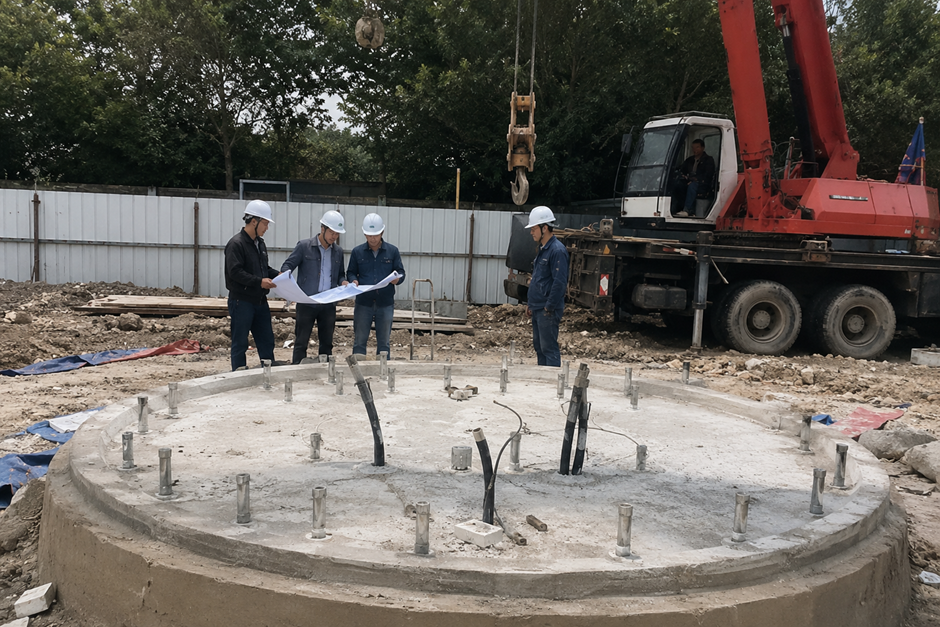
Site preparation should be completed before delivery whenever possible.
Clients should not assume that the installation contractor can resolve every issue after the sculpture reaches the site. Delays may result in storage costs, additional crane hire, unsafe temporary positioning, or damage caused by repeated handling.
Before delivery, the site team should verify:
- Foundation dimensions
- Anchor locations
- Foundation strength and curing
- Crane access
- Delivery vehicle access
- Ground conditions
- Working area
- Required permits
- Electrical or lighting connections
- Nearby landscape completion
- Protection of finished surfaces
Pegasus recommends sharing current site photographs and measurements before dispatch, particularly when the project has changed since the original installation plan was developed.
The manufacturer and local installation team should also agree on the lifting points, rigging method, assembly order, anchoring procedure, and final alignment requirements.
Stage 11: Installation and Final Handover
Installation is the point where all earlier design, engineering, production, logistics, and site-planning decisions come together.
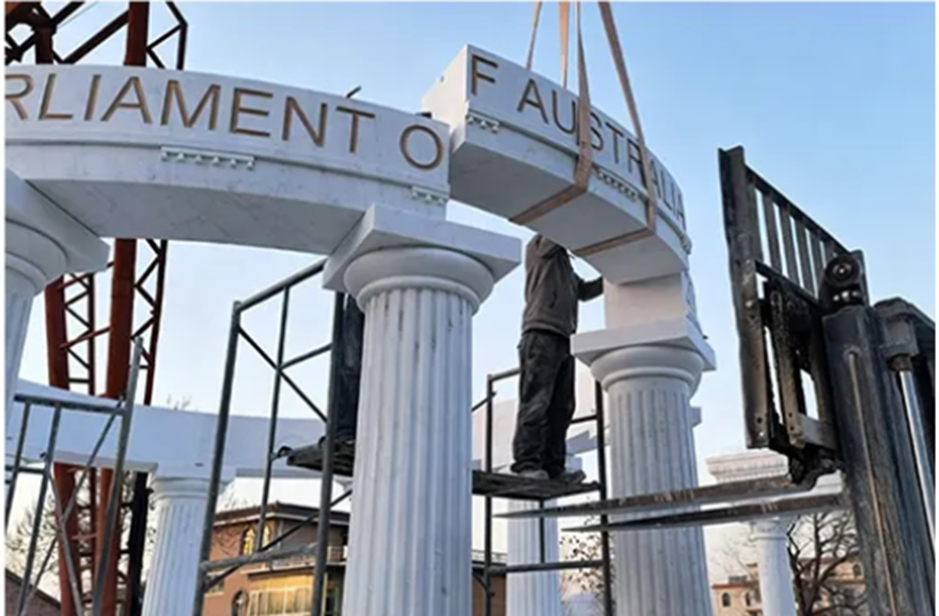
Depending on the size and design, installation may involve:
- Uncrating and condition inspection
- Crane lifting
- Positioning on the foundation
- Assembly of separate sections
- Installation of anchors or support components
- Joint treatment
- Final alignment
- Surface cleaning
- Minor finishing corrections
- Site acceptance
The client should expect a defined installation sequence and clear allocation of responsibilities.
For international projects, Pegasus may provide drawings, technical guidance, installation instructions, or coordination with the local team according to the agreed scope. The local contractor should understand the sculpture’s weight, lifting points, connection system, and required equipment before work begins.
After installation, the sculpture should be inspected from both technical and visual perspectives.
The final review may confirm:
- Correct orientation
- Stable anchoring
- Accurate joint alignment
- Surface condition
- Relationship to the surrounding architecture
- Completion of cleaning and touch-up work
- Handover of maintenance guidance
A successful installation should not feel like a separate activity added at the end. It should be the planned result of decisions made throughout the commission.
A Project-Based Example: Why Early Coordination Matters
Consider a hospitality developer commissioning a large abstract marble sculpture for the entrance courtyard of a luxury resort.
The initial concept may appear straightforward: a flowing contemporary form installed on a stone pedestal. However, the project review reveals several important considerations:
- The sculpture will be visible from multiple elevations.
- Its marble must coordinate with the resort façade without disappearing against it.
- The access route restricts the size of the delivery vehicle.
- The courtyard can only accommodate a crane before landscaping is completed.
- The final design contains a narrow transition requiring structural review.
- The foundation must be completed by the local contractor before shipping.
Rather than beginning production immediately, Pegasus would first help the project team refine the dimensions, review the fragile section, select an appropriate marble block, confirm the pedestal connection, and coordinate the installation sequence.
The sculpture might then be divided at a visually discreet location to simplify transportation. The joint, support system, and assembly process would be designed before carving rather than improvised at the site.
Progress reviews would allow the client and architect to confirm proportions and finish. Packing would follow the approved installation sequence, and the delivery programme would be coordinated with the crane and landscape schedule.
The value of this approach extends beyond manufacturing the sculpture. It gives the buyer greater control over cost, timing, approvals, logistics, and installation while protecting the artistic intent.
This is why Pegasus approaches a commission as a complete project. The recommendation is based not only on knowledge of marble but on understanding how design, manufacturing, transportation, and installation affect one another in real commercial environments.
What Clients Should Expect from the Right Marble Sculpture Partner
By the end of the commissioning process, the client should have received more than a finished sculpture.
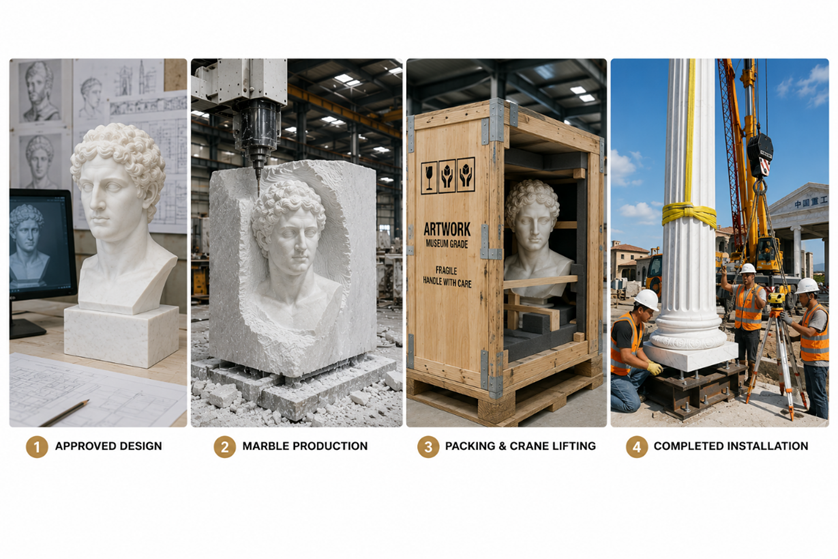
A capable manufacturing partner should provide:
- Clear project requirements
- Practical design feedback
- Appropriate stone recommendations
- Defined engineering and installation planning
- Transparent commercial scope
- Structured approvals
- Production visibility
- Documented quality checks
- Suitable packing and logistics
- Installation coordination
Most importantly, the manufacturer should help the client understand why each recommendation is being made.
A recommendation to strengthen a section, change the stone orientation, adjust a dimension, divide the sculpture, or modify the lifting strategy should be connected to a real project requirement. Clients should not be expected to accept unexplained changes simply because they come from the factory.
Pegasus’s role is therefore not limited to acting as a marble statue supplier. Its engineering, production, quality-control, and project teams work together to help clients move confidently from an initial artistic idea to a completed installation.
Conclusion
Commissioning a contemporary marble sculpture is a collaborative buyer journey involving much more than approving a design and waiting for carving to finish.
The decisions made during concept development, stone selection, engineering, approvals, logistics, and installation directly affect the sculpture’s quality, cost, delivery, and long-term performance.
Based on Pegasus’s experience delivering commercial sculpture projects, the most successful commissions are those in which these stages are coordinated from the beginning. Early planning allows artistic ambition to be balanced with manufacturing feasibility, structural requirements, transportation realities, and site conditions.
By working with a manufacturer that understands the complete project—not only the marble carving process—clients gain clearer expectations, better control over risk, and greater confidence throughout the commission.
To discuss a custom marble sculpture for a hospitality, architectural, public art, commercial, or private development, clients can contact the Pegasus team and share their concept, proposed dimensions, site information, and project timeline.
Frequently Asked Questions
What information should I provide when requesting a marble sculpture quotation?
Clients should provide concept images, approximate dimensions, installation location, indoor or outdoor use, preferred marble colour, target delivery date, site information, and an approximate budget. More detailed information allows the manufacturer to prepare a more accurate recommendation and quotation.
When should engineering and installation planning begin?
Engineering and installation planning should begin during concept development, before the final design enters production. Early review helps identify structural, foundation, transport, lifting, and site-access requirements before they create delays or design changes.
Can clients approve the marble block before production?
Yes. For commissioned sculptures, clients should normally review photographs or videos of the proposed block, including its colour, veining, dimensions, and visible natural characteristics before carving begins.
Will the client receive updates during manufacturing?
The approval process should be agreed before production. Clients may receive progress updates during rough shaping, proportion review, detailing, finishing, quality inspection, and packing, depending on the project scope.
Can a large contemporary marble sculpture be produced in sections?
Yes. Large sculptures may be divided because of marble block availability, structural requirements, shipping dimensions, lifting capacity, or site access. The sectioning and joint strategy should be planned before carving so that assembly does not compromise the final appearance.
How is a marble sculpture protected during international shipping?
Protection may include a custom timber crate, internal supports, soft wrapping, foam, reinforcement around projecting details, moisture protection, and handling instructions. The packing arrangement should be designed for the specific sculpture.
Who is responsible for installing the sculpture?
Responsibility depends on the agreed project scope. Installation may be completed by the manufacturer, a specialist contractor, or a local team working with technical information supplied by the manufacturer. Roles should be confirmed before production and shipping.
How early should a marble sculpture be commissioned?
The project should begin as early as possible, particularly when it requires design development, a large stone block, engineering, client approvals, international shipping, or coordination with a construction programme. The final schedule should be established after the manufacturer reviews the complete scope.